Digital detour · 1896
The Night the “Martians” Made the Paper
The newspaper story is real. The seven-foot visitors almost certainly were not.
- Place
- Approximate historic Cherokee Road corridor south of Lodi
- Chapter
- Field note
- Time here
- 6 minutes
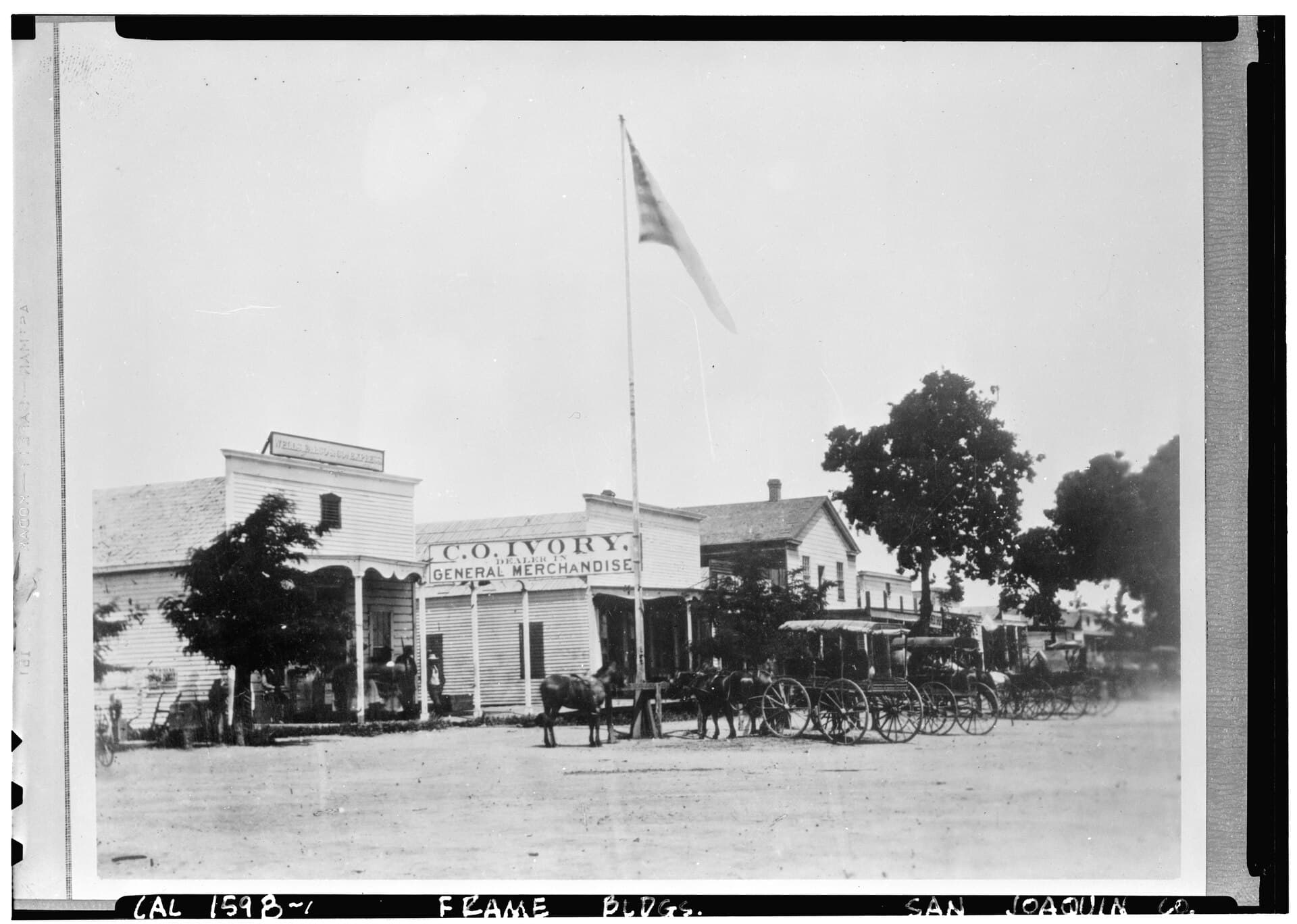
A historic Lodi commercial street scene. Context image; it does not necessarily depict this stop.
Historic American Buildings Survey, HABS CAL,39-LODI,1-1 / Library of Congress. Public domain. (opens in a new tab)Audio story · 6:28
Listen where the story happened.
No on-site orientation. This is a remote-only chapter tied to an approximate historic area with no safe or appropriate roadside stop.
Listen to the story
The player stays with you while you open the route, sources, or next chapter.
Complete transcript
Do not go looking for the spot
This is a digital detour. Do not drive toward the map point or stop along the historic Cherokee Road corridor. The location is approximate, access is not appropriate, and there is no verified roadside site to visit.
You do not need one. The surviving object at the center of this story is not a building or landscape feature. It is a newspaper account.
In 1896, the Stockton Evening Mail published H. G. Shaw's story of an encounter near Lodi. The article is real. The nearly weightless seven-foot visitors almost certainly were not.
Three strange beings
Shaw claimed that he and a companion encountered tall, unusual beings near an airship. In the published account, the figures were difficult to hold because they seemed remarkably light. Shaw alleged that they attempted to carry the men toward the craft.
That is what the source establishes: a newspaper printed his allegation. It does not establish that the encounter occurred.
The distinction sounds obvious, yet extraordinary stories often collapse it. “A newspaper reported” gradually becomes “it happened.” A named witness and a printed column can lend authority to a narrative even when the narrative is satire, invention, exaggeration, or a performance aimed at the reader.
The original clipping matters because it anchors the legend in time. Whatever Shaw intended, people in 1896 could encounter this strange story as newsprint. The account entered public circulation long before modern flying-saucer culture supplied the images we now associate with alien encounters.
Before the flying saucer
Notice the technology in the story: an airship.
Late nineteenth-century readers lived amid rapid technological change and speculation about flight. Newspapers carried reports of mysterious airships during the period. The unknown arrived in a form that belonged to the era's imagination.
That is one clue that legends are historical even when their central events are not factual. They borrow the machinery, anxieties, humor, and expectations available to their first audience. A later retelling may translate those elements into “aliens” or “Martians,” but the original text belongs to a different media world.
We should avoid pretending to know exactly how every 1896 reader interpreted the piece. Some may have believed it. Some may have recognized satire. Some may simply have enjoyed a bizarre story. The article's survival tells us it was printed, not how belief distributed across the audience.
The likeliest explanation
A modern investigation by Guinness World Records concludes that satire or a yellow-journalism hoax is the likeliest explanation.
“Likeliest” is the right word. It expresses a reasoned conclusion without claiming access to Shaw's private intent. The account contains extraordinary physical claims without extraordinary evidence. It appears in a media environment known for sensational competition. Its narrative qualities make sense as entertainment or satire.
That conclusion does not make the item historically worthless. A hoax can reveal more about a culture than a mundane true event. It shows what editors thought might attract attention, what forms of technological wonder felt plausible enough to play with, and how a local place name could give a strange tale specificity.
The pleasure comes from watching the story operate—not from asking you to believe the beings were real.
The danger of being first
Modern accounts sometimes describe Shaw's story as an early—or even the earliest published—alien-abduction narrative. Claims of “first” are seductive. They turn a curious clipping into a milestone.
They are also difficult to prove. Earlier material may remain undiscovered, untranslated, poorly indexed, or defined differently. Does an abduction attempt count? Must the beings come from another planet? Does satire qualify? The answer depends on the category.
This atlas therefore centers the claim we can verify: the Stockton Evening Mail published Shaw's strange encounter story in 1896. The modern investigation places it within the great mystery-airship episode and argues for hoax or satire. That is plenty.
If later scholarship sharpens the “first” claim, the transcript can change. Until then, novelty should not outrun evidence.
The newspaper is the artifact
The map point for this chapter is only a proxy. The real historical site is the page: ink, column space, a headline, a named storyteller, and readers deciding what to make of it.
That makes this a useful ending for an evidence-led atlas. Not every story needs a surviving building. Not every published account deserves belief. A source can be authentic while the event it describes remains unproven or implausible.
The article is real. Shaw made the claim. The nearly weightless beings and attempted carrying-away are allegations, not facts. A modern investigation finds satire or yellow-journalism hoax the most likely answer.
And yet the story traveled. It outlived its original paper, gathered new labels, and attached Lodi to a history of mysterious-airship and alien-abduction storytelling.
Enjoy the tale. Keep the receipt. And do not go looking for seven-foot visitors along a road that was never established as a visitor destination in the first place.
Read the place
A chapter is an argument built from checkable claims—not a pile of local trivia.
In 1896, a newspaper published Colonel H. G. Shaw's account of strange, nearly weightless beings and an attempted abduction near Lodi. A modern investigation concludes that satire or yellow-journalism hoax is the likeliest explanation.
Why it matters
The pleasure is not pretending aliens visited Lodi. It is watching a nineteenth-century media story mutate into what may be the earliest published alien-abduction narrative.
Evidence ledger
The story, claim by claim.
The central account comes from a credible source but has not been independently confirmed. Every receipt names the source and the exact place to look.
How the evidence key worksClaim 01
DocumentedIn 1896, the Stockton Evening Mail published H. G. Shaw's account of an encounter near Lodi.
Receipts
- SupportsThree Strange Beings (opens in a new tab)Original newspaper clipping
Claim 02
ReportedShaw claimed—not proved—that tall, nearly weightless beings tried to carry him and a companion toward an airship.
Receipts
- SupportsThree Strange Beings (opens in a new tab)Original newspaper clipping
- ContextThe First Alien Abduction and the Great Mystery Airship Flap of 1896 (opens in a new tab)Reconstruction of Shaw's allegation
Claim 03
ReportedGuinness World Records' investigation concludes that satire or a yellow-journalism hoax is the likeliest explanation.
Receipts
- SupportsThe First Alien Abduction and the Great Mystery Airship Flap of 1896 (opens in a new tab)Analysis and conclusion
Source shelf
Read past the plaque.
Source notes say what each record establishes—and just as importantly, what it does not.
- 01Three Strange Beings (opens in a new tab)Primary record
The Stockton Evening Mail via Newspapers.com · 1896-11-27
Primary evidence that the allegation was published, not evidence that nonhuman beings or an abduction attempt existed.
Accessed 2026-09-03 · link only
- 02The First Alien Abduction and the Great Mystery Airship Flap of 1896 (opens in a new tab)Local retrospective
Guinness World Records · 2026-06
Documents the published claim and argues that satire or yellow-journalism hoax is the likely explanation.
Accessed 2026-09-03 · link only
Beyond the walking route
This bonus chapter sits outside the nine-stop walk.
Return to the route whenever you are ready to follow the downtown story in order.
Return to the route