Stop 02 · 1907 / 1918
Built for a Carnival
Built for spectacle. Later used as a stage for public loyalty.
- Place
- 1 E. Pine Street
- Chapter
- promise
- Time here
- 9 minutes
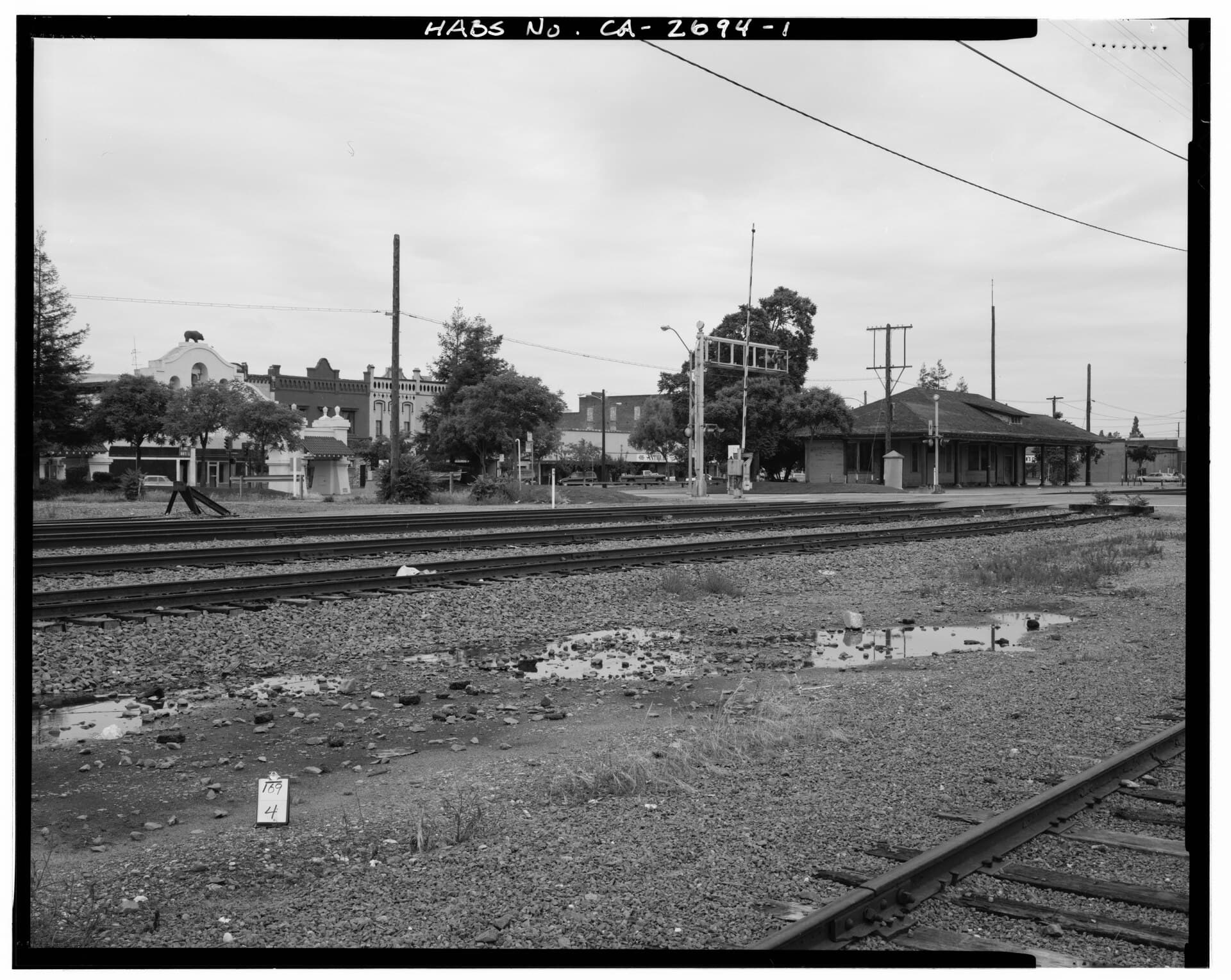
The Southern Pacific passenger depot and Mission Arch, photographed for the Historic American Buildings Survey in 1998.
David De Vries / HABS CA-2694 / Library of Congress. Public domain. (opens in a new tab)Audio story · 5:47
Listen where the story happened.
Stand in public space where the full Mission Arch is visible. Look first at its span, then at the street passing beneath it.
Listen to the story
The player stays with you while you open the route, sources, or next chapter.
Complete transcript
A gateway is a claim
Find a place in public space where you can see the whole Mission Arch without stepping into traffic. Look at the span first. Then look through it, toward the ordinary street continuing on the other side.
An arch makes a simple claim: crossing this line means you have arrived somewhere important. In 1907, Lodi built this one for spectacle. The city wanted an entrance, an image, and a public promise. A decade later, local historical accounts say the same structure carried a much harder message about who counted as fully American.
This chapter remains a research preview while community review is underway. Listen to it as an examination of changing civic meaning, not a final word.
The promise of Tokay
Designed by E. B. Brown, the Mission Arch was built in 1907 as the ceremonial entrance to the Tokay Carnival. The Tokay grape was more than produce. It was part of the image Lodi projected: fertile land, abundance, celebration, and a place confident enough to stage itself for visitors.
Imagine the arch in that setting. It is not defensive. It is welcoming. Its job is to frame arrival and make a local festival feel larger than a single day. Architecture turns promotion into something permanent. Long after banners come down and crowds go home, the gateway remains.
The arch is now listed in the National Register of Historic Places and designated California Historical Landmark Number 931. Those designations tell us the structure has recognized historical importance. They do not settle every meaning the arch has carried. A landmark can be documented and still be contested. In fact, the more public the symbol, the more likely people are to use it for purposes its designer never anticipated.
The message changes
According to the Lodi Historical Society, in 1918 the arch carried a large electrified sign reading, “FOR 100% AMERICANS.” The Society also reports that the gateway became a stage for wartime effigies.
Hold those words against the architecture you see. A structure created to announce welcome was used to broadcast a test of loyalty. The United States was at war. Suspicion and public pressure focused on antiwar voices and people associated with German identity. The phrase “one hundred percent American” did not simply express affection for country. In that moment, it could demand visible conformity and imply that some neighbors were less trustworthy than others.
We are deliberately not adding dramatic details that the current source record does not securely establish. Exact dimensions for the sign, individual prosecutions, and reported penalties remain outside this script until primary records are logged. Restraint is part of the story. Public fear often produces vivid retellings. Our job is to separate what has been responsibly sourced from what has merely become memorable.
Read the symbol twice
Look at the arch again, but read it twice.
First, see the 1907 object: a ceremonial gateway for a carnival, tied to Lodi's agricultural self-invention. Then see the 1918 platform described by the Historical Society: electricity, a slogan, public pressure, and a symbol recruited into wartime politics.
Neither reading cancels the other. That is the difficult value of preserving public landmarks. They allow a city to encounter more than one version of itself in the same physical place.
The temptation is to force a verdict: pride or exclusion, celebration or intimidation. History is usually less cooperative. Civic pride can produce beauty, generosity, and shared identity. It can also narrow the definition of belonging. The same gateway can welcome visitors while asking residents to prove themselves. The architecture did not change. The message did.
Who gets to pass beneath it
Before moving on, watch someone pass under the arch—or imagine the next person who will. They do not need to present credentials. They simply cross.
That ordinary freedom gives the landmark a different meaning today, but it does not erase the older one. The useful question is not whether the Mission Arch is a good symbol or a bad symbol. The useful question is what a city asks its symbols to do, especially when it feels prosperous, threatened, or eager to define itself.
The documented record supports the arch's 1907 construction, designer, original carnival purpose, and landmark status. The 1918 sign and effigy account is attributed to the Lodi Historical Society and remains subject to deeper primary-source work and community review.
Built for spectacle. Later used as a stage for public loyalty. The arch survives because the city valued it. What it means now depends partly on whether we are willing to see the whole record beneath it.
Read the place
A chapter is an argument built from checkable claims—not a pile of local trivia.
The Mission Arch welcomed visitors to the 1907 Tokay Carnival. A decade later, local historical accounts say the same gateway carried an enormous pro-American sign while wartime suspicion focused on antiwar and German residents.
Why it matters
One landmark can hold two versions of civic pride: exuberant self-invention and the pressure to prove who belonged.
Evidence ledger
The story, claim by claim.
The central account comes from a credible source but has not been independently confirmed. Every receipt names the source and the exact place to look.
How the evidence key worksClaim 01
DocumentedDesigned by E. B. Brown, the Mission Arch was built in 1907 as the ceremonial entrance to the Tokay Carnival.
Evidence note: The inventory's narrative overview contains an inconsistent 1934 sentence; the dedicated City and designation records support 1907.
Receipts
- SupportsMission Arch (opens in a new tab)Design & Purpose
- SupportsLodi Arch — California Historical Landmark No. 931 (opens in a new tab)Landmark record No. 931
- SupportsHistorical Resource Inventory: Lodi Downtown Specific Plan Area (opens in a new tab)Appendix C: Lodi Arch
Claim 02
DocumentedThe Arch is listed in the National Register and designated California Historical Landmark No. 931.
Receipts
- SupportsHistorical Resource Inventory: Lodi Downtown Specific Plan Area (opens in a new tab)Appendix C: status codes 1S and 1CL
- SupportsLodi Arch — California Historical Landmark No. 931 (opens in a new tab)Landmark record No. 931
Claim 03
ReportedThe Lodi Historical Society reports that in 1918 the Arch carried a large electrified “FOR 100% AMERICANS” sign and became a stage for wartime effigies.
Evidence note: Exact sign dimensions, individual prosecutions and jail penalties remain outside the approved copy pending primary records.
Receipts
- SupportsLodi Historical Society Newsletter Archive (opens in a new tab)World War I newsletter issue in archive
Source shelf
Read past the plaque.
Source notes say what each record establishes—and just as importantly, what it does not.
- 01Mission Arch (opens in a new tab)Local retrospective
City of Lodi
Supports the 1907 construction and Tokay Carnival purpose; does not substantiate the later wartime stories.
Accessed 2026-09-03 · link only
- 02
California Office of Historic Preservation
Official state designation record for the Mission Arch.
Accessed 2026-09-03 · link only
- 03
GPA Consulting · City of Lodi · 2026-01
Authoritative for the survey's resource-status findings. The 118 properties are reconnaissance candidates, not designated landmarks; narrative chronology still requires claim-level checking.
Accessed 2026-09-03 · link only
- 04Lodi Historical Society Newsletter Archive (opens in a new tab)Local retrospective
Lodi Historical Society
Deep local-history archive. Individual wartime, fire and building claims remain attributed until their cited primary records are logged separately.
Accessed 2026-09-03 · link only
Next stop · 03
One Roadside Glass
Before the drive-in, there was one roadside root-beer stand.