Stop 03 · 1919
One Roadside Glass
Before the drive-in, there was one roadside root-beer stand.
- Place
- Reported site: 13 W. Pine Street
- Chapter
- prosperity
- Time here
- 6 minutes
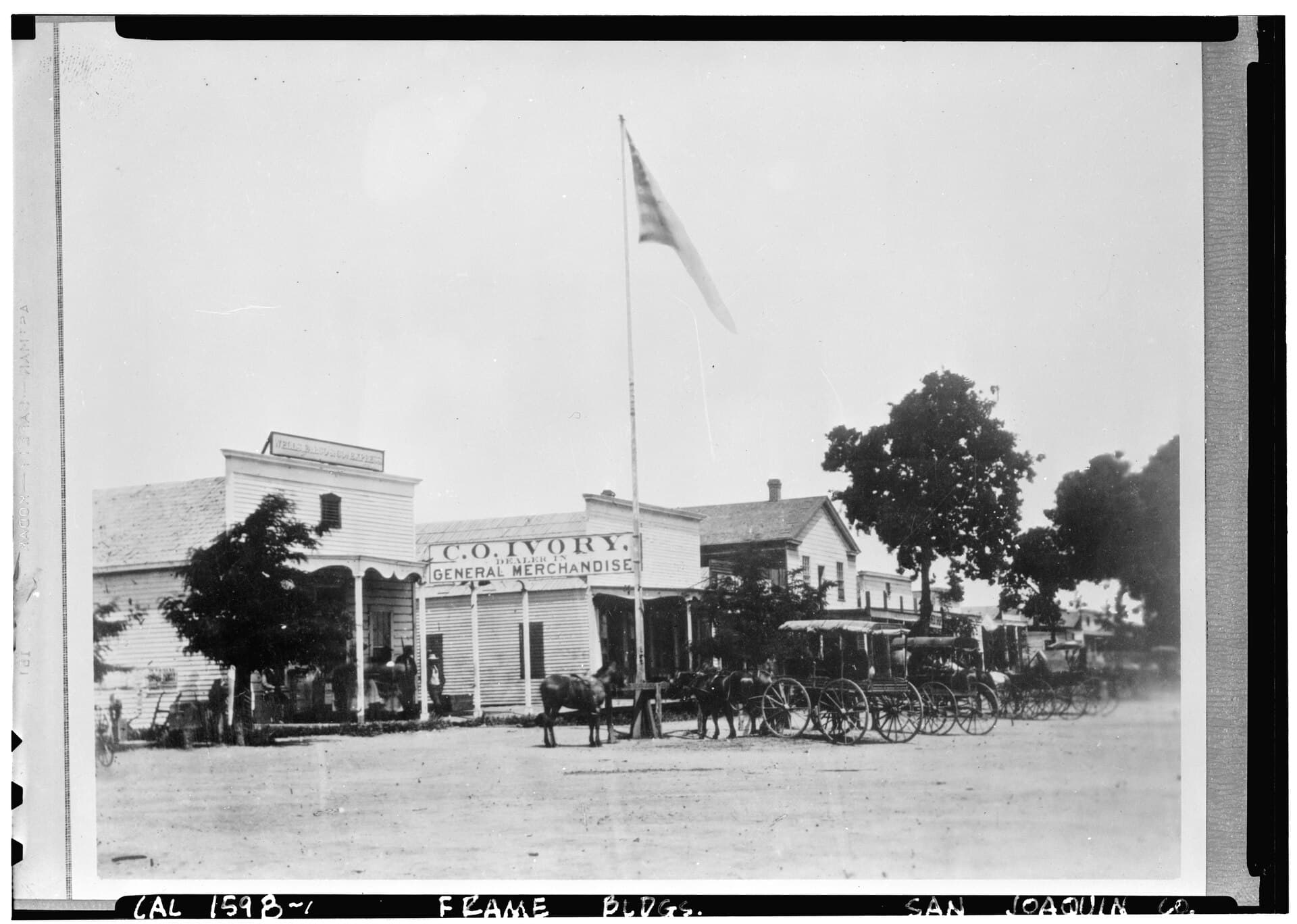
A historic Lodi commercial street scene. Context image; it does not necessarily depict this stop.
Historic American Buildings Survey, HABS CAL,39-LODI,1-1 / Library of Congress. Public domain. (opens in a new tab)Audio story · 5:01
Listen where the story happened.
Remain on the public sidewalk along the reported 13 West Pine Street block. Use the marker as the reference point; do not treat any current storefront as the proven footprint.
Listen to the story
The player stays with you while you open the route, sources, or next chapter.
Complete transcript
Start with what is here
Stay on the public sidewalk and find the historical marker on this Pine Street block. Treat the marker—not any particular modern storefront—as your reference point.
That distinction is important. A&W dates its beginning to a roadside root-beer stand opened by Roy Allen in Lodi in 1919. The marker identifies this block as the birthplace site. But the exact historic footprint still needs directory and Sanborn-map research. So begin with the honest version: something nationally familiar started near here, while the precise patch of ground remains an open archival question.
A product before a system
Forget the later image of a drive-in for a moment. Forget trays clipped to car windows, branded mugs, franchised menus, and signs visible from a highway. Start with one roadside stand and one drink.
That smaller beginning makes the story more interesting. A brand can become so familiar that it feels inevitable. Once you know the orange-and-brown logo, it is hard to recover the uncertainty of the first sale. But in 1919 there was no guarantee that a root-beer stand in Lodi would become anything beyond a local transaction.
The roadside mattered. The product met people in motion. Lodi's earlier growth had been organized by the railroad; this story belongs to the emerging culture of roads, personal travel, and quick refreshment. The city was not merely exporting agricultural goods. It became the origin point for a retail idea that could travel.
The birthplace problem
Birthplace stories attract details. Opening days become ceremonies. Customers become crowds. A simple stand gains a perfect address and a polished origin scene. Some of those details may eventually prove true. They are not automatically true because they make the story better.
Our current evidence has two useful layers. A&W's own history dates the company's origin to Roy Allen's Lodi roadside stand in 1919. A local marker places the beginning on this Pine Street block. What we do not yet have in the approved record is enough contemporary material to fix the exact footprint or support every colorful version of opening day.
That uncertainty does not weaken the chapter. It shows how public history works. A marker is evidence that a claim has been publicly attached to a place. It is not the same thing as a directory entry, parcel record, period advertisement, photograph, or fire-insurance map. Those sources can confirm, refine, or sometimes unsettle what a marker tells us.
Imagine the scale change
Look along the block and imagine the difference between a roadside stand and a national system. The stand requires a person, a product, and passing customers. A chain requires repeatable recipes, recognizable branding, supply, agreements, training, and trust that the experience in one town can be reproduced in another.
The first glass does not contain all of that. It contains the possibility of it.
Lodi often tells its story through vineyards and wine. A&W adds a different kind of agricultural and commercial identity: a prepared drink, sold directly to travelers, eventually standardized and distributed far beyond the place where it began. The product was not a grape, but the logic is familiar. Grow something—or make something—locally, then build a way for the wider world to recognize it.
Leave room for the next record
Before you go, read the marker's wording closely. Notice what it states, what it implies, and what it leaves out. That is a useful habit for every stop on this route.
The responsible version of the story is already remarkable: A&W traces its origin to Roy Allen's roadside root-beer stand in Lodi in 1919, and this block carries the public birthplace marker. We do not need to manufacture certainty beyond that.
One roadside glass became a national brand. The exact spot can wait for the records. History is not less satisfying when a question remains open. Sometimes the unresolved detail is an invitation: look at the city directory, find the old map, locate the advertisement, and make the story more precise than the plaque could manage.
Read the place
A chapter is an argument built from checkable claims—not a pile of local trivia.
A&W dates its beginning to Roy Allen's 1919 roadside stand in Lodi. A local historical marker places that beginning on this Pine Street block, although the exact footprint and opening-day story still need archival confirmation.
Why it matters
A product poured beside a Lodi road became a national brand—an unusually tangible example of the city exporting more than grapes.
Evidence ledger
The story, claim by claim.
The central account comes from a credible source but has not been independently confirmed. Every receipt names the source and the exact place to look.
How the evidence key worksClaim 01
ReportedA&W dates its origin to a roadside root-beer stand opened by Roy Allen in Lodi in 1919.
Receipts
- SupportsAbout A&W (opens in a new tab)Pioneers in the Industry
Claim 02
ReportedA historical marker identifies this Pine Street block as the birthplace site; directory and Sanborn research is still needed to fix the original stand's exact footprint.
Evidence note: Do not add the June 20 date or returning-soldiers parade claim without a discrete contemporary citation.
Receipts
- SupportsBirthplace of A&W Root Beer (opens in a new tab)Marker location and inscription
Source shelf
Read past the plaque.
Source notes say what each record establishes—and just as importantly, what it does not.
- 01About A&W (opens in a new tab)Institutional history
A&W Restaurants, Inc.
A&W dates its origin to Roy Allen's 1919 roadside stand in Lodi. It does not establish the exact address, opening day or parade story.
Accessed 2026-09-03 · link only
- 02Birthplace of A&W Root Beer (opens in a new tab)Research lead
Historical Marker Database
Useful lead for the 13 W. Pine Street location; the marker is not independent proof of every origin detail.
Accessed 2026-09-03 · link only
Next stop · 04
Hotel, Theater and Fire
The grand hotel stayed visible. Its theater disappeared in plain sight.