Stop 06 · 1876
The Building and the Missing Eagle
The building is still here. The enormous rooftop eagle is not.
- Place
- 47 N. Sacramento Street
- Chapter
- afterlife
- Time here
- 6 minutes
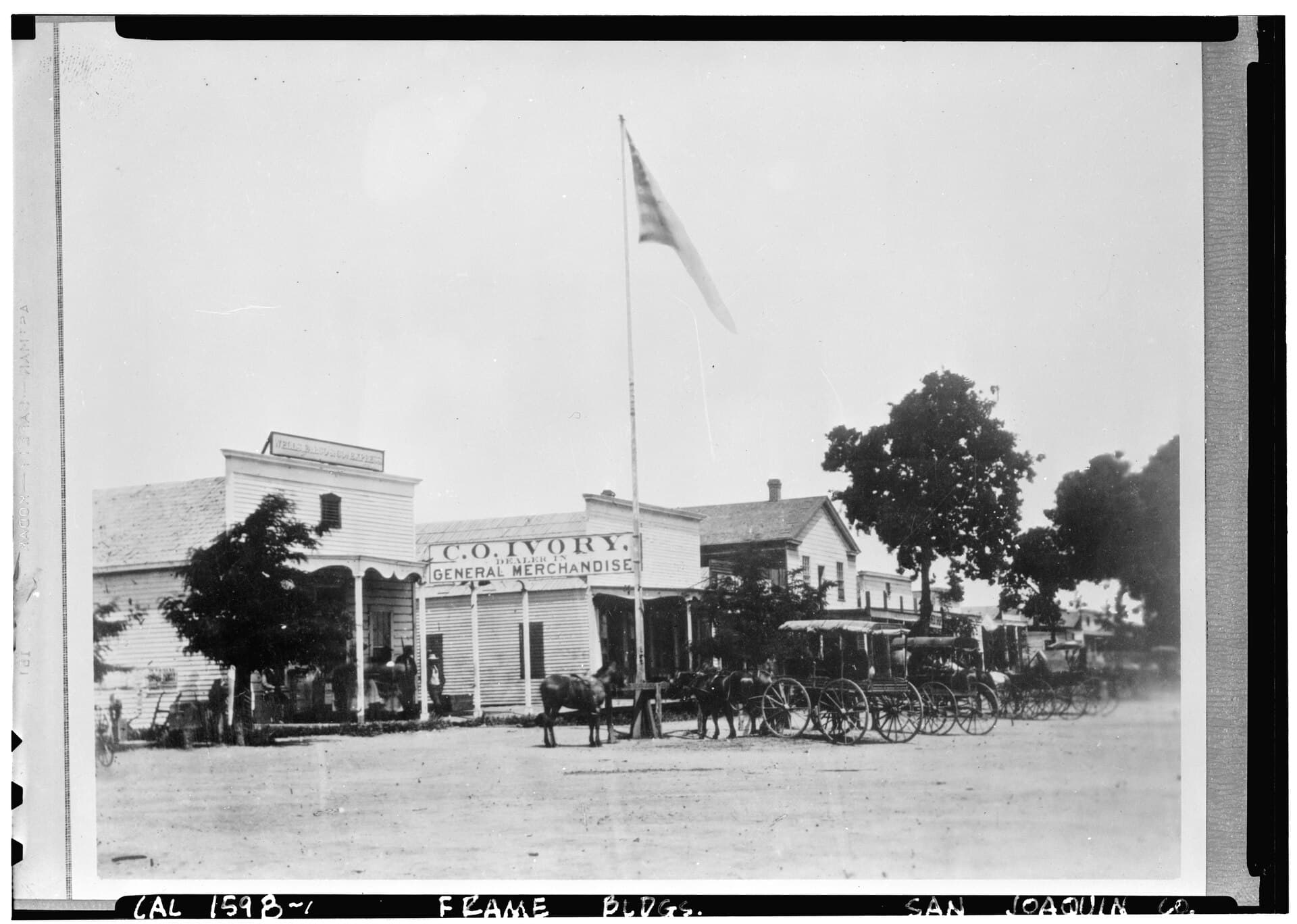
A historic Lodi commercial street scene. Context image; it does not necessarily depict this stop.
Historic American Buildings Survey, HABS CAL,39-LODI,1-1 / Library of Congress. Public domain. (opens in a new tab)Audio story · 5:14
Listen where the story happened.
From the public sidewalk opposite 47 North Sacramento Street, find the roofline before studying the storefront level.
Listen to the story
The player stays with you while you open the route, sources, or next chapter.
Complete transcript
Look where something is missing
Remain on the public sidewalk and find the building at 47 North Sacramento Street. Start at the roofline, not the storefront.
You are looking for an absence. Historic photographs reproduced by Explore Lodi appear to show a large eagle mounted above this building. In later images, it is gone. We do not yet know when it disappeared, why it was removed, who took it down, or where it went.
That is the whole mystery. No ghost, no invented theft, no tidy ending. A building survives. An object does not. The gap between the two turns looking into research.
What the survey establishes
The City's January 2026 historical survey records the Granger's Building as an 1876 resource identified at reconnaissance level. Its status code is 7R.
That does not mean the building is a designated landmark. It means the survey identified it as a candidate deserving further attention. The distinction matters because preservation language can easily inflate. “Historic” becomes “protected.” “Potentially eligible” becomes “listed.” A preliminary survey becomes a final judgment.
This atlas will not make that leap. The building's age and candidate status are documented. The next steps—deeper evaluation, context, integrity analysis, and any formal designation process—belong to a different level of review.
The result is still meaningful. An 1876 candidate stands in front of you. It has occupied this commercial street through changing businesses, signs, facades, traffic, and public taste.
The photograph as witness
Now return to the roofline and imagine the eagle's scale. The historic-photo comparison is doing specific work. It does not tell us the object's full story. It shows that an object appears in one visual record and later disappears from view.
Photographs feel transparent, but they have their own limits. A camera records one angle, one moment, one crop, one quality of light. The eagle might be clear in one image and hidden in another. A later photograph can establish absence from view without establishing the reason for absence.
To solve the mystery, researchers might look for dated photographs, building permits, newspaper items, business records, insurance files, city directories, or memories tied to the property. Each source could narrow the time window. None should be forced to say more than it does.
The fun here is disciplined curiosity. The eagle is memorable enough to invite speculation. The responsible response is not to suppress imagination. It is to label imagination as imagination and keep searching.
Ordinary buildings are archives
At street level, a commercial building can blend into the daily city. People pass for errands, work, food, or conversation. Most do not stop to compare the roofline with a historic photograph.
That ordinary use is not a failure. Buildings remain alive partly because they keep serving the present. But ordinary use can make historical evidence harder to see. Paint changes. Windows change. Signs hide openings. Decorative objects vanish. A facade becomes so familiar that nobody asks why it looks the way it does.
The missing eagle gives you a method you can carry anywhere: look high, compare dates, distinguish the structure from its attachments, and treat change as evidence. A city is not only a collection of surviving landmarks. It is a field of partial records.
Do not solve what is not solved
Take one last look at the empty roofline.
There is a temptation in storytelling to reward attention with an answer. Here, the honest reward is a better question. The City documents an 1876 reconnaissance-level candidate. Historic images appear to document a rooftop eagle. Later images no longer show it. Its fate is unknown.
That final sentence is not an admission of failure. It is a boundary around the evidence. It tells future researchers exactly where the work begins.
When you move on, remember the building and the missing object together. Preservation often celebrates what remains. Historical investigation also needs to notice what left—and to resist filling every empty place with a story merely because silence feels unfinished.
Read the place
A chapter is an argument built from checkable claims—not a pile of local trivia.
The City's inventory records the Granger's Building as an 1876 reconnaissance-level candidate. Historic images reproduced by Explore Lodi show a large rooftop eagle that later disappears from the photographic record.
Why it matters
Historic buildings are evidence, but they are incomplete evidence. The missing eagle turns ordinary looking into a real research act without inventing an answer.
Evidence ledger
The story, claim by claim.
The central account comes from a credible source but has not been independently confirmed. Every receipt names the source and the exact place to look.
How the evidence key worksClaim 01
DocumentedThe City’s January 2026 survey records the Granger's Building as an 1876 candidate—identified at reconnaissance level, not designated as a landmark.
Receipts
- SupportsHistorical Resource Inventory: Lodi Downtown Specific Plan Area (opens in a new tab)Appendix D, resource 51; Status Code 7R
Claim 02
ReportedHistorical photographs reproduced by Explore Lodi appear to show a rooftop eagle that later vanished from view. Its fate is unknown.
Receipts
- SupportsHistory's Mysteries: Do You Know Where They Are? (opens in a new tab)47 N. Sacramento Street photo comparison
Source shelf
Read past the plaque.
Source notes say what each record establishes—and just as importantly, what it does not.
- 01
GPA Consulting · City of Lodi · 2026-01
Authoritative for the survey's resource-status findings. The 118 properties are reconnaissance candidates, not designated landmarks; narrative chronology still requires claim-level checking.
Accessed 2026-09-03 · link only
- 02History's Mysteries: Do You Know Where They Are? (opens in a new tab)Local retrospective
Explore Lodi
Documents the local missing-eagle question through dated images; it does not establish the ornament's fate.
Accessed 2026-09-03 · link only
Next stop · 07
Two Blocks, a Whole World
Two blocks held a whole community. Federal forced removal and incarceration broke it apart.