Stop 08 · 1912 / 1942
When Lodi Went Dark
When the horn sounded, the town went dark.
- Place
- 114 N. Main Street
- Chapter
- fracture
- Time here
- 7 minutes
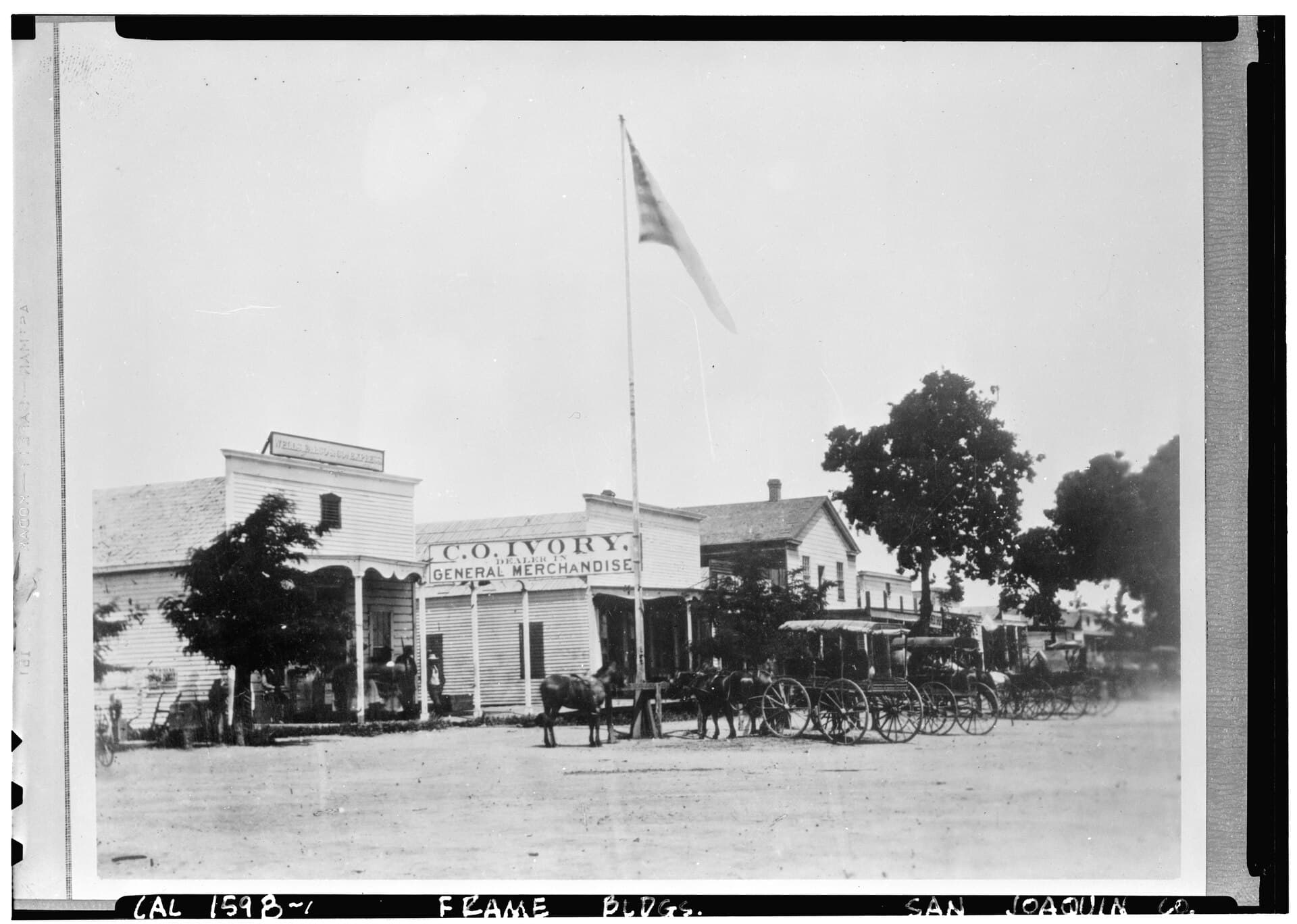
A historic Lodi commercial street scene. Context image; it does not necessarily depict this stop.
Historic American Buildings Survey, HABS CAL,39-LODI,1-1 / Library of Congress. Public domain. (opens in a new tab)Audio story · 5:09
Listen where the story happened.
From the public sidewalk at 114 North Main Street, locate the former City Hall and Firehouse and look toward the upper exterior where a civic signal could carry beyond the building.
Listen to the story
The player stays with you while you open the route, sources, or next chapter.
Complete transcript
One building, concentrated authority
Stay on the public sidewalk and locate the former City Hall and Firehouse. Look at the building as a system, not only a facade.
Government administration and emergency response once occupied the same municipal complex. Decisions, records, alarms, equipment, and public authority were concentrated here. During the Second World War, local historical accounts say an air horn at this building signaled blackout and all-clear during civil-defense drills.
One sound could tell a city to change its behavior.
The machinery of a young city
The City's historical survey dates the first City Hall and Fire Station to 1912. It identifies the building as a reconnaissance-level candidate, not a designated landmark.
That date places the complex in a period when Lodi was giving permanent form to municipal functions. A city hall makes government visible. A firehouse makes collective risk visible. Combining them suggests a practical civic center: the place where the city keeps records, organizes response, and demonstrates that some problems must be handled together.
The survey status again asks for careful language. The building has been identified as potentially significant at a preliminary level. It has not been granted the formal status that the word “landmark” might imply. You can value a building without overstating its legal or evaluative standing.
Rehearsing darkness
The Lodi Historical Society reports that an air horn here signaled blackout and all-clear during World War Two civil-defense drills.
Imagine the instruction moving outward from this point. The horn sounds. Residents darken windows and reduce visible light. Ordinary homes and businesses become part of a coordinated defense exercise. The city practices making itself harder to see from the sky.
The feared attack did not arrive here, but the rehearsal was real. That distinction matters. A drill is an event even when the catastrophe it anticipates never occurs. It changes schedules, rooms, streets, and attention. It teaches people how institutions expect them to behave under threat.
We are not adding exact counts of wardens or observation schedules because those details still need primary civil-defense records. The approved account is narrower: the building served as the base for a horn used to signal blackout and all-clear, according to the Historical Society.
A city governed by sound
Look away from the building and consider the distance a horn must cross to be useful. Its audience is not the person standing at the door. Its audience is the town.
Before phones could push an alert into every pocket, civic warning systems depended on shared signals: bells, sirens, horns, radio, messengers, and posted instructions. The system worked only if people recognized the sound, trusted its meaning, and knew what to do next.
That creates a temporary relationship between municipal power and private life. A sound issued from a public building reaches into a bedroom, shop, kitchen, or street and asks for immediate compliance. During a blackout drill, darkness becomes collective. One bright window can feel like a public failure.
The emotional history is easy to exaggerate, so stay with the physical facts: a municipal complex, an attributed horn signal, darkened windows, and residents rehearsing for danger. Those details are enough to make distant wartime anxiety local.
The all-clear
Imagine two sounds rather than one: the signal to go dark and the signal that ordinary light may return.
Between them, the city waits. That interval is the chapter. Municipal authority has issued an instruction, residents have altered private spaces, and everyone listens for release.
The old City Hall and Firehouse makes this history spatially legible. It concentrated the functions capable of warning, organizing, and responding. The Historical Society's account connects that civic machinery to World War Two blackout drills. The City's survey establishes the building's 1912 date and reconnaissance-level status.
When you leave, notice the alerts your own phone can produce. Modern warnings feel personal because they arrive on an individual device. The horn worked differently. It made everyone within earshot part of the same public moment.
When the horn sounded, Lodi went dark. When the all-clear came, the city returned to itself—but with the knowledge that it had practiced becoming invisible.
Read the place
A chapter is an argument built from checkable claims—not a pile of local trivia.
The 1912 City Hall and Firehouse concentrated municipal authority in one building. Local historical accounts say its air horn later signaled World War II blackout drills while residents watched the sky for an attack that never came.
Why it matters
The building turns an abstract home-front fear into a physical system: one horn, darkened windows and a city rehearsing catastrophe.
Evidence ledger
The story, claim by claim.
The central account comes from a credible source but has not been independently confirmed. Every receipt names the source and the exact place to look.
How the evidence key worksClaim 01
DocumentedThe City's survey dates the first City Hall and Fire Station to 1912 and identifies it as a reconnaissance-level candidate, not a designated landmark.
Receipts
- SupportsHistorical Resource Inventory: Lodi Downtown Specific Plan Area (opens in a new tab)Appendix D, resource 114
Claim 02
ReportedThe Lodi Historical Society reports that an air horn here signaled blackout and all-clear during World War II civil-defense drills.
Evidence note: Exact warden counts and observation-post schedules remain outside approved copy until primary civil-defense records are logged.
Receipts
- SupportsLodi Historical Society Newsletter Archive (opens in a new tab)World War II, Part 1 newsletter issue
Source shelf
Read past the plaque.
Source notes say what each record establishes—and just as importantly, what it does not.
- 01
GPA Consulting · City of Lodi · 2026-01
Authoritative for the survey's resource-status findings. The 118 properties are reconnaissance candidates, not designated landmarks; narrative chronology still requires claim-level checking.
Accessed 2026-09-03 · link only
- 02Lodi Historical Society Newsletter Archive (opens in a new tab)Local retrospective
Lodi Historical Society
Deep local-history archive. Individual wartime, fire and building claims remain attributed until their cited primary records are logged separately.
Accessed 2026-09-03 · link only
- 03Lodi Preservation Alliance (opens in a new tab)Local retrospective
Lodi Preservation Alliance
Organization-level preservation context. Specific building claims still require a stable record-level citation.
Accessed 2026-09-03 · link only
Next stop · 09
The Park and the Grape Strike
Workers asked for higher wages. Firefighters answered a crowd with hoses.