Stop 09 · 1933
The Park and the Grape Strike
Workers asked for higher wages. Firefighters answered a crowd with hoses.
- Place
- 209 E. Locust Street
- Chapter
- reckoning
- Time here
- 12 minutes
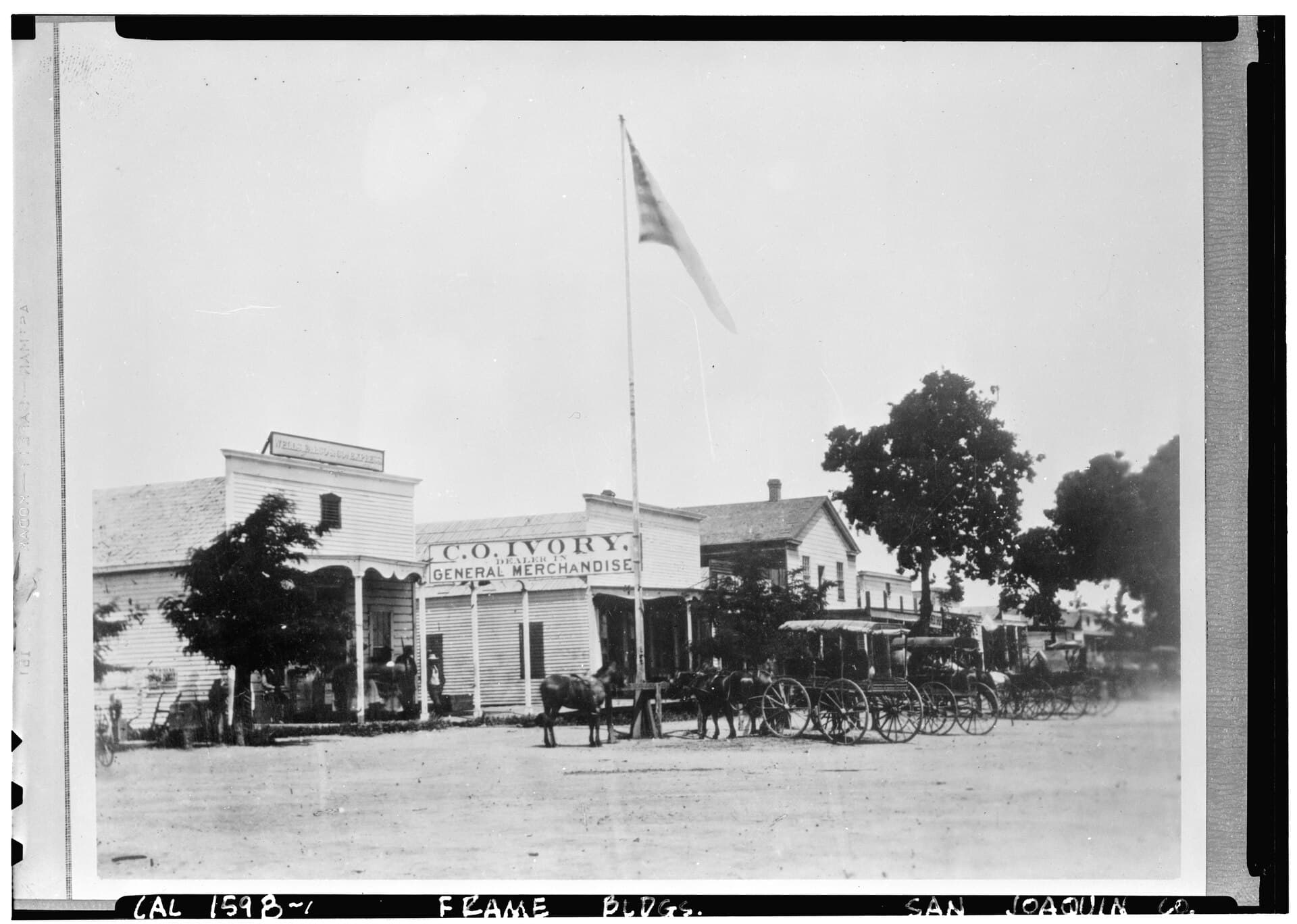
A historic Lodi commercial street scene. Context image; it does not necessarily depict this stop.
Historic American Buildings Survey, HABS CAL,39-LODI,1-1 / Library of Congress. Public domain. (opens in a new tab)Audio story · 7:30
Listen where the story happened.
From public space at Hale Park, take in the open gathering area and its edges before focusing on any monument or present-day activity.
Listen to the story
The player stays with you while you open the route, sources, or next chapter.
Complete transcript
A park is also political space
Find a place in public space where you can take in the park without interfering with anyone using it. Look at the open area, then at the streets and buildings around its edges.
A park can host play, rest, celebration, and ordinary neighborhood life. It can also become a place where people assemble because being visible together creates power. In 1933, during a strike in Lodi's grape economy, this park became part of a conflict over wages, harvest, policing, and who could control public space.
This chapter remains subject to community and expert review. The goal is not to stage a confrontation for visitors. It is to put labor back inside Lodi's agricultural history.
Twenty-five cents and forty cents
A history published by the Lodi Winegrape Commission reports that growers offered roughly twenty-five cents an hour and workers voted to strike for forty cents.
Those numbers are small enough to sound abstract now. Their historical meaning lies in the difference between them. Fifteen cents per hour represented food, rent, clothing, debt, and a worker's judgment about what the labor was worth. For growers, wage rates affected the cost and timing of bringing in a crop. Harvest does not wait indefinitely while people negotiate.
That pressure made the conflict more than a disagreement at a table. Workers could withhold labor. Growers and business leaders could mobilize money, influence, law enforcement, and replacement labor. Each side occupied a different position in the local economy, and those differences shaped what happened next.
Lodi's wine identity is often narrated through soil, climate, grape varieties, families, and enterprise. Every one of those stories also contains labor. Grapes do not harvest themselves. A landscape celebrated for abundance can still contain a dispute over who receives the value produced from it.
The conflict reaches the park
Contemporary newspaper reporting documents violence during the strike. A later sourced account says firefighters used hoses to disperse a large crowd at this park while growers and business leaders mobilized special deputies and a vigilante committee.
We are keeping exact crowd sizes, deputy counts, vigilante numbers, and roundup figures attributed rather than presenting them as settled fact. Quantities become politically charged during conflict. Different participants and newspapers may count, label, and justify the same gathering differently.
The central physical account is already stark. Firefighters—public servants and workers themselves—used water pressure to move people out of a public gathering space. A tool associated with protecting the city from fire became an instrument of crowd control.
Pause.
Do not imagine the crowd as scenery. Each person arrived with a position, risk, relationship, and reason. Some were striking workers. Others may have been supporters, opponents, officials, observers, or people caught near the confrontation. The surviving record needs more names and voices, not a more cinematic reconstruction.
Who can organize force
Look at the park's edges again. Public space is never isolated from the institutions around it.
A strike tests more than wages. It tests which groups can coordinate. Workers organize a refusal to work. Growers organize to protect the harvest. Business leaders organize around commercial stability. Officials decide how law and public order will be interpreted. Newspapers choose language that can make a crowd seem legitimate, dangerous, or both.
The later historical account describes special deputies and a vigilante committee mobilized during the conflict. Those terms require careful sourcing because they reveal how private interests and public authority can overlap. The precise structure deserves deeper study, but the broader question belongs here now: when an economic conflict escalates, who has access to organized force?
That question changes how we see the park. It was not merely the location where a crowd happened to gather. It became terrain in a struggle over visibility, movement, labor, and control.
The harvest story after the strike
One local historical account traces the idea for a grape festival to a post-strike banquet for officers, firefighters, and volunteers. We present that as an attributed interpretation, not as the festival's single settled origin or only meaning.
The connection is uncomfortable and therefore important to investigate. Festivals can create real joy, identity, commerce, and continuity. They can also shape which parts of a harvest story become public celebration and which parts recede from view.
If a post-conflict banquet helped generate the festival idea, then the civic memory of grapes may have been organized partly by the people who considered the strike defeated. That does not invalidate every later festival experience. It does mean the origin story should be examined with the labor conflict beside it, not separated from it.
Public history becomes more honest when it allows celebration and conflict to occupy the same landscape.
Put labor back into the landscape
Take in the park once more as it is now. Nothing about present-day grass, paths, trees, or activity automatically reveals a 1933 wage dispute. The history becomes visible only when evidence is connected to place.
The sourced record tells us that workers sought forty cents against an offer of roughly twenty-five. Contemporary reporting documents violence. A later account describes firefighters using hoses here and local power mobilizing deputies and vigilantes. That same retrospective connects a post-strike banquet to the later festival idea.
Each statement carries its source and level of certainty. More review may sharpen the language and recover additional perspectives.
When people say Lodi is grape country, remember that this includes the hands that cut, carried, sorted, and packed the crop. It includes the people who owned land and the people who sold their labor. It includes festivals—and it includes the moment workers gathered in a park to say the offered wage was not enough.
Read the place
A chapter is an argument built from checkable claims—not a pile of local trivia.
During the 1933 grape strike, Municipal Park became a center of assembly and coercion. Contemporary reporting documents violence; a later sourced history describes firefighters dispersing a large crowd here and growers and business leaders mobilizing deputies and vigilantes.
Why it matters
Lodi's wine identity usually begins with soil and grapes. Hale Park forces the story to include labor, wages and the public power used to protect a harvest.
Evidence ledger
The story, claim by claim.
The central account is supported by a primary record or multiple independent, credible sources. Every receipt names the source and the exact place to look.
How the evidence key worksClaim 01
ReportedA Lodi Winegrape Commission history reports that growers offered roughly 25 cents an hour and workers voted to strike for 40 cents.
Receipts
- SupportsStory of an Appellation — Part 5: History of Lodi Labor and Grape Festival Memories (opens in a new tab)The labor movement in Lodi, paragraphs 12–14
Claim 02
DocumentedContemporary reporting documents the strike's violence; a later sourced account says firefighters used hoses to disperse a large crowd at this park while growers and business leaders mobilized special deputies and a vigilante committee.
Evidence note: Exact crowd, deputy, vigilante and roundup counts remain source-attributed rather than stated as settled fact.
Receipts
- SupportsViolence Flares in Lodi Grape Strike (opens in a new tab)Front-page strike coverage, October 5, 1933
- SupportsStory of an Appellation — Part 5: History of Lodi Labor and Grape Festival Memories (opens in a new tab)The labor movement in Lodi, paragraphs 15–23
Claim 03
ReportedOne local historical account traces the festival idea to a post-strike banquet for officers, firefighters and volunteers. Treat that origin as an attributed interpretation, not the festival's only meaning.
Receipts
- SupportsStory of an Appellation — Part 5: History of Lodi Labor and Grape Festival Memories (opens in a new tab)Banquet and first Grape Festival discussion
Source shelf
Read past the plaque.
Source notes say what each record establishes—and just as importantly, what it does not.
- 01
Madera Tribune via California Digital Newspaper Collection · 1933-10-05
Contemporary coverage of the strike conflict; period language and allegations require attribution.
Accessed 2026-09-03 · link only
- 02Story of an Appellation — Part 5: History of Lodi Labor and Grape Festival Memories (opens in a new tab)Local retrospective
Randy Caparoso · Lodi Winegrape Commission · 2023-10-24
Detailed sourced retrospective. Crowd sizes and the festival-origin interpretation are presented publicly with attribution.
Accessed 2026-09-03 · link only
End of the line