Stop 05 · 1909–1928
The Civic Spine
A library and a city hall turned civic ambition into brick, stone and public rooms.
- Place
- 221–305 W. Pine Street
- Chapter
- promise
- Time here
- 8 minutes
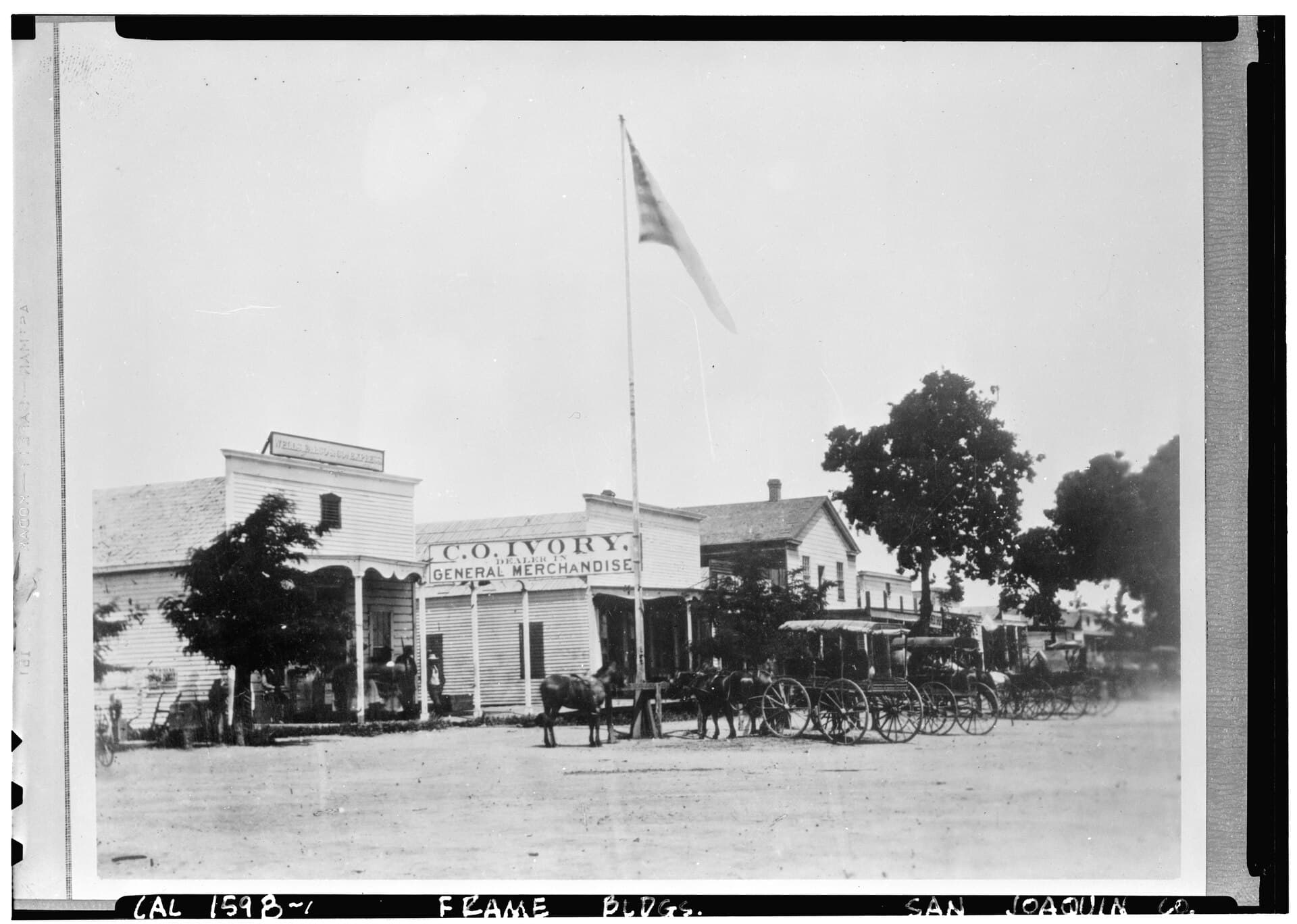
A historic Lodi commercial street scene. Context image; it does not necessarily depict this stop.
Historic American Buildings Survey, HABS CAL,39-LODI,1-1 / Library of Congress. Public domain. (opens in a new tab)Audio story · 5:05
Listen where the story happened.
From the public sidewalk on West Pine Street, identify the Carnegie Library and City Hall as two parts of one civic landscape.
Listen to the story
The player stays with you while you open the route, sources, or next chapter.
Complete transcript
Read the block, not one building
Stay on the public sidewalk and locate both anchors of this civic landscape: the Carnegie Library and City Hall. You may need to turn or move your gaze rather than your feet. This is a block-scale chapter.
The two buildings do different work. One organizes knowledge and public access. The other organizes government. Together they make an argument in brick, stone, entrances, and meeting rooms: Lodi intended to become more than a place of private businesses and passing trains. It intended to build a civic life.
Institutions take form
The City's historical inventory dates the Carnegie Library to 1909 and 1910, and City Hall to 1927 and 1928. Both are listed in the California Register.
Those dates place the buildings in different moments of Lodi's growth. The library arrives first, close to the era of the depot, Mission Arch, and Opera House. City Hall follows nearly two decades later. The gap reminds us that a civic spine is not designed all at once. It accumulates as a community decides which institutions deserve permanent rooms and a public face.
Registration status helps establish significance, but it does not tell the full social story. A building can survive with its architecture documented while the work of people inside it remains thinly recorded. This stop asks you to notice both the monument and the organizing that made the monument possible.
A public room for knowledge
Look at the library and think about the radical simplicity of its promise: people may enter and use knowledge that they do not personally own.
Carnegie libraries across the country carried assumptions about education, citizenship, order, and improvement. Here, we should resist turning that broad national pattern into unsupported local detail. What the current Lodi record establishes is the building's date, significance, and place in the city's civic landscape.
But the physical form still allows questions. Who could enter comfortably? Which books and newspapers were available? Who selected them? Whose language and history appeared on the shelves? Public institutions widen access, yet they also reflect the values and exclusions of the communities that create them. A complete history needs both truths.
Power outside formal office
The Woman's Club of Lodi records women organizing around the city's library and civic life. That institutional history gives us an important thread, not a finished account.
At a time when formal political power was constrained, civic clubs could become places where women raised money, built networks, advocated for institutions, and shaped public priorities. The minutes, correspondence, membership records, and city documents needed to tell that work in full deserve deeper research.
For now, stand between the idea of library and the idea of city hall. One building may look cultural, the other political. In practice, civic power moves between them. People organize, persuade, fund, petition, administer, and preserve. Not all of that work comes with an elected title or a name carved into stone.
This is why architectural history cannot stop at style. The question is not only who designed a building. It is who made the institution possible, who used it, and whose labor became invisible once the doors opened.
What a city makes public
Look from one building to the other one last time. Their survival gives Lodi a visible civic lineage. Their California Register status confirms recognized historical value. But preservation is not completion. The buildings are containers for stories still being recovered.
A railroad line can cause a town to form. Businesses can make it prosperous. Civic institutions ask a different question: what will the community hold in common?
The library answers with access to knowledge. City Hall answers with the machinery of government. The Woman's Club thread reminds us that public life is also built by people whose influence may sit outside formal office.
Carry that wider definition of power to the next chapter. Buildings leave clues in plain sight, but the absence of a plaque, title, or surviving object does not mean the absence of work. Sometimes the city we inherit is only the outer shell of the civic effort that built it.
Read the place
A chapter is an argument built from checkable claims—not a pile of local trivia.
The Carnegie Library and City Hall anchor Lodi's west Pine Street civic landscape. Both are California Register-listed resources; the Woman's Club's own history also records women's organizing within the city's library and civic movement.
Why it matters
These buildings make governance and civic participation visible—and open a path to recover who raised money, organized institutions and was excluded from formal power.
Evidence ledger
The story, claim by claim.
The central account is supported by a primary record or multiple independent, credible sources. Every receipt names the source and the exact place to look.
How the evidence key worksClaim 01
DocumentedCity Hall and the Carnegie Library are both listed in the California Register.
Receipts
- SupportsHistorical Resource Inventory: Lodi Downtown Specific Plan Area (opens in a new tab)Table 2 and Appendix C: status code 2S2
Claim 02
DocumentedThe City's inventory dates the Carnegie Library to 1909–1910 and City Hall to 1927–1928.
Receipts
- SupportsHistorical Resource Inventory: Lodi Downtown Specific Plan Area (opens in a new tab)Appendix C: City Hall and Carnegie Library
Claim 03
ReportedThe Woman's Club's institutional history records women organizing around Lodi's library and civic life—a thread that deserves deeper work in club minutes and city records.
Receipts
- SupportsWoman's Club of Lodi History (opens in a new tab)Club history
Source shelf
Read past the plaque.
Source notes say what each record establishes—and just as importantly, what it does not.
- 01
GPA Consulting · City of Lodi · 2026-01
Authoritative for the survey's resource-status findings. The 118 properties are reconnaissance candidates, not designated landmarks; narrative chronology still requires claim-level checking.
Accessed 2026-09-03 · link only
- 02Woman's Club of Lodi History (opens in a new tab)Institutional history
Woman's Club of Lodi
Institutional account of local women's civic work; broader claims should be corroborated through minutes and city records.
Accessed 2026-09-03 · link only
Next stop · 06
The Building and the Missing Eagle
The building is still here. The enormous rooftop eagle is not.