Stop 04 · 1887–1915
Hotel, Theater and Fire
The grand hotel stayed visible. Its theater disappeared in plain sight.
- Place
- 5–10 S. School Street
- Chapter
- prosperity
- Time here
- 9 minutes
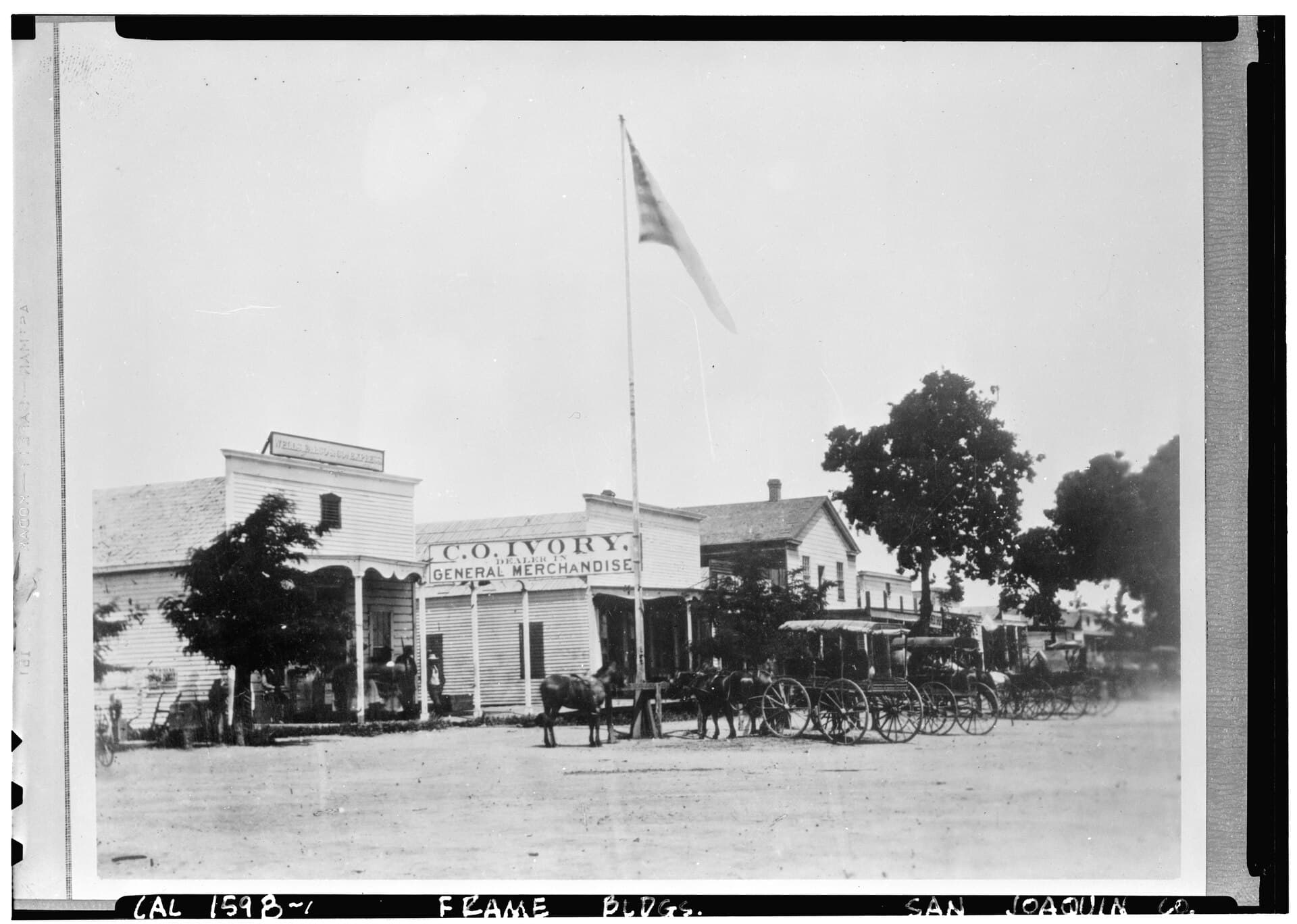
A historic Lodi commercial street scene. Context image; it does not necessarily depict this stop.
Historic American Buildings Survey, HABS CAL,39-LODI,1-1 / Library of Congress. Public domain. (opens in a new tab)Audio story · 5:32
Listen where the story happened.
From the public sidewalk at Pine and School Streets, take in the surviving Hotel Lodi, then look across the story block toward the upper floors associated with the former Opera House.
Listen to the story
The player stays with you while you open the route, sources, or next chapter.
Complete transcript
Three downtowns in one block
Stand on the public sidewalk where you can take in the corner without blocking an entrance. Find Hotel Lodi first. Let its scale register. Then look across the story block and raise your eyes toward the upper floors.
This stop holds three versions of downtown at once: destruction in 1887, entertainment in a locally documented 1905 Opera House, and the surviving 1915 hotel. One block, three acts. Fire clears part of the stage. A theater appears. A hotel later declares a different kind of ambition.
The city that could burn
City histories report that in 1887 fire destroyed much of downtown along Sacramento Street. We are keeping that claim broad because the more dramatic details—the precise ignition point, a hot-bearing theory, and an exact duration—still need stronger primary documentation before they belong in the public narration.
Even without those details, the event asks you to imagine a downtown more vulnerable than the one around you now. Fire was not merely damage to individual buildings. It could erase businesses, rooms, records, livelihoods, and the physical memory of how a street had looked the day before.
After a major fire, rebuilding is not restoration in the literal sense. People do not simply put the same town back. They make decisions about materials, scale, use, appearance, and the future they expect. Destruction becomes an involuntary planning meeting, conducted through money, urgency, and unequal power.
The theater above the street
Local historical materials identify a 1905 Opera House in an upper story across from the later hotel. Look upward again.
An opera house in a growing town was not only a place for opera. Buildings with that name could host performances, lectures, meetings, traveling acts, and civic gatherings. The important spatial fact is that public culture could occupy a room above ordinary street commerce. From sidewalk level, the building might now read as storefronts and windows. The performance space can disappear in plain sight even if part of the structure survives.
That is one reason a walking tour needs audio. Text can tell you a theater existed. A voice, heard while you physically raise your eyes, can change how you read the facade. The goal is not to recreate sounds we cannot document. It is to restore the possibility that these upper floors once held a public interior with its own audiences, expectations, and nights out.
A new face for arrival
Now return your attention to Hotel Lodi. Built in 1915, it is one of downtown's two National Register-listed buildings.
A hotel is a city looking outward. It assumes strangers will arrive, need a room, judge the place, and carry an impression away. Its architecture becomes part of the city's argument about itself. By 1915, Lodi was not presenting only a railroad stop or a festival gateway. It could offer a substantial downtown building intended to meet visitors at urban scale.
The hotel survives visibly. The Opera House is harder to read. The 1887 streetscape is gone. That uneven survival can distort memory. We naturally give more attention to what still occupies space. The absent theater and the earlier burned downtown require records, imagination, and disciplined language. They are not less important because they are less visible.
Rebuilding is an edit
Take in the block one final time as an edited document. The fire removed. Builders added. Owners changed uses. Time hid some evidence and preserved other pieces. Historic designation later elevated the hotel within the public record.
The point is not that downtown Lodi rose heroically from ashes in one clean arc. Real cities rebuild unevenly. Some people recover faster. Some stories gain plaques and status. Others retreat into upper floors, newsletters, maps, and memories.
What we can responsibly say is clear: a major 1887 fire devastated much of downtown along Sacramento Street; local materials place an Opera House here in 1905; and the 1915 Hotel Lodi remains a nationally listed landmark. Together they show a city repeatedly changing the public image it wanted this block to carry.
When you leave, do not just remember the largest building. Remember the invisible room above the street and the earlier city beneath both of them.
Read the place
A chapter is an argument built from checkable claims—not a pile of local trivia.
This block compresses three generations of downtown ambition: the 1887 fire that devastated Sacramento Street, the locally documented 1905 Opera House and the 1915 Hotel Lodi that still commands the corner.
Why it matters
Instead of treating a building as a static artifact, this block shows how Lodi repeatedly rebuilt the public image it wanted visitors to see.
Evidence ledger
The story, claim by claim.
The central account comes from a credible source but has not been independently confirmed. Every receipt names the source and the exact place to look.
How the evidence key worksClaim 01
ReportedIn 1887, fire destroyed much of downtown along Sacramento Street.
Evidence note: The precise ignition point, hot-bearing theory and 45-minute duration remain attributed research details, not approved copy.
Receipts
- SupportsHistory of the City of Lodi (opens in a new tab)Continued Growth
- SupportsLodi Historical Timeline (opens in a new tab)1887 entry
Claim 02
DocumentedBuilt in 1915, Hotel Lodi is one of downtown's two National Register-listed buildings.
Receipts
- SupportsHotel Lodi National Register of Historic Places Registration Form (opens in a new tab)Items 2, 5, 7 and 8
- SupportsHistorical Resource Inventory: Lodi Downtown Specific Plan Area (opens in a new tab)Appendix C: Hotel Lodi
Claim 03
ReportedLocal historical materials identify a 1905 Opera House hidden in the upper story across from the later hotel.
Receipts
- SupportsLodi Historical Society Newsletter Archive (opens in a new tab)Opera House material indexed in newsletter archive
Source shelf
Read past the plaque.
Source notes say what each record establishes—and just as importantly, what it does not.
- 01History of the City of Lodi (opens in a new tab)Local retrospective
City of Lodi
Useful municipal overview; it is a later summary rather than a contemporaneous record.
Accessed 2026-09-03 · link only
- 02Lodi Historical Timeline (opens in a new tab)Local retrospective
City of Lodi
Municipal chronology; specific addresses and causes require primary-source checking.
Accessed 2026-09-03 · link only
- 03Hotel Lodi National Register of Historic Places Registration Form (opens in a new tab)Official record
National Park Service
Official nomination and architectural documentation for Hotel Lodi at 5 S. School Street.
Accessed 2026-09-03 · link only
- 04
GPA Consulting · City of Lodi · 2026-01
Authoritative for the survey's resource-status findings. The 118 properties are reconnaissance candidates, not designated landmarks; narrative chronology still requires claim-level checking.
Accessed 2026-09-03 · link only
- 05Lodi Historical Society Newsletter Archive (opens in a new tab)Local retrospective
Lodi Historical Society
Deep local-history archive. Individual wartime, fire and building claims remain attributed until their cited primary records are logged separately.
Accessed 2026-09-03 · link only
Next stop · 05
The Civic Spine
A library and a city hall turned civic ambition into brick, stone and public rooms.