Stop 01 · 1869
The Stop That Became Lodi
Lodi began as a stop before it became a town.
- Place
- 24 S. Sacramento Street
- Chapter
- arrival
- Time here
- 7 minutes
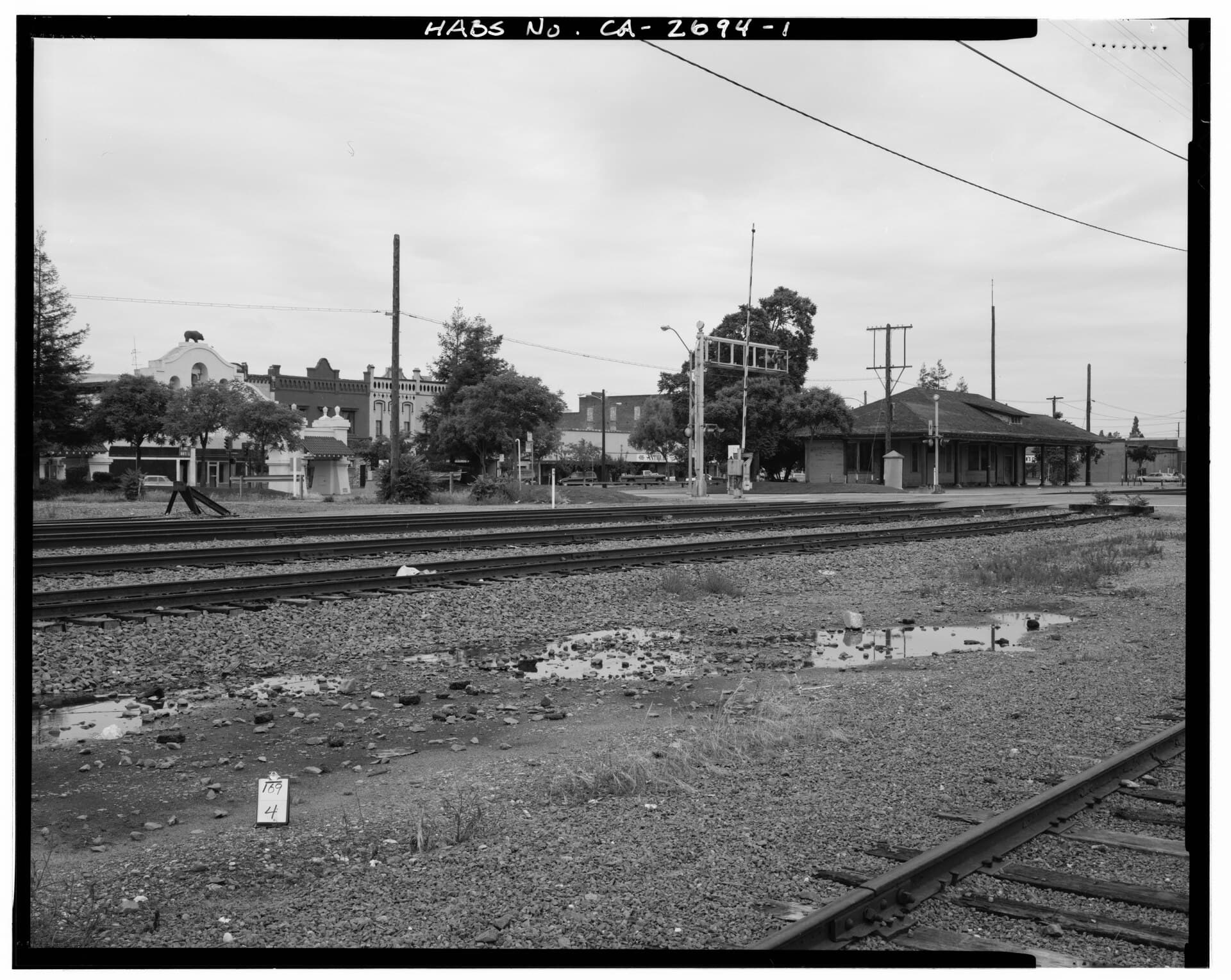
The Southern Pacific passenger depot and Mission Arch, photographed for the Historic American Buildings Survey in 1998.
David De Vries / HABS CA-2694 / Library of Congress. Public domain. (opens in a new tab)Audio story · 5:37
Listen where the story happened.
From public space at Lodi Station, face the historic depot and then look along the railroad line in both directions.
Listen to the story
The player stays with you while you open the route, sources, or next chapter.
Complete transcript
Find the line
Before you look at the depot, look past it. Find the rails and follow their line with your eyes in both directions. That line is the oldest piece of city planning in front of you. Lodi did not begin with a courthouse square, a harbor, or a grand civic avenue. It began as a stop on a railroad.
Now bring your attention back to the depot. The building you see is historic, but its position is not original. That matters. At this first stop, the city and the building are both stories about movement.
A place organized by arrival
City histories date the railroad reservation here to July 17, 1869. They describe the settlement developing around the station. Notice how different that is from saying a town simply appeared and then gained a railroad. The sequence runs the other way. First came the transportation line and the promise of connection. The shape of the town followed.
Railroads compress distance. They turn crops into shipments, isolated settlements into stops, and stops into places that can imagine a future. But they also impose geometry. Tracks divide land. Businesses face the traffic that brings customers. Warehouses, streets, and neighborhoods arrange themselves around access. Even now, downtown Lodi still carries the consequences of that first organizing line.
Stand here for a moment and imagine the place before the present station complex, before paved streets, before the familiar name on signs. A rail reservation is an administrative fact on paper. On the ground, it becomes anticipation: a whistle, a timetable, people waiting, freight moving, and the repeated decision to build close to the line rather than far from it.
The building moves
The City of Lodi dates the opening of the Southern Pacific passenger depot to June 22, 1907. By then, the stop had become a city confident enough to give arrival a proper architectural face.
But the depot's story did not freeze in 1907. The building was later moved to make room for a longer platform. It reopened at this site in October 1999. So the structure in front of you is both artifact and adaptation: an old building serving a transportation system that kept changing around it.
That relocation creates a useful historical warning. Buildings feel authoritative because they are physical. We can point to brick, timber, doors, and rooflines and say, there it is. Yet a surviving building does not automatically tell us where it stood, how it was used at every moment, or what disappeared around it. Physical evidence is powerful, but it still needs records and context.
Listen for the city beneath the city
If a train is nearby, let the sound enter the story. If the tracks are quiet, imagine the contrast between waiting and arrival. A station is defined by both.
The railroad moved more than grapes and passengers. It moved information, expectations, labor, money, and attention. It told outsiders that this place was reachable, and it told residents that somewhere else was reachable too. That two-way promise helped make Lodi.
The city eventually built civic landmarks, hotels, stores, gathering places, and symbols of its own identity. You will meet those in later chapters. But underneath each of them is this first proposition: connection can create a place. It can also divide one. Look across the tracks and notice how a single line produces two sides. That is not a metaphor invented for the tour. It is something the city still asks you to navigate with your body.
Carry the question
Before you leave, look once more at the depot, then at the rails. Ask which is the real monument: the preserved building, or the line that caused the town to organize itself here.
The evidence supports a careful answer. City histories place the reservation in 1869. The City dates the depot to 1907 and its reopening here to 1999. Those dates do not give us every voice or every consequence. They give us a durable frame.
Lodi began as a stop before it became a town. Everything that follows is what people chose to build around that stop—and what later generations chose to move, preserve, forget, or recover. When you are ready, return to the route. Your phone can identify the nearest available chapter without storing your location.
Read the place
A chapter is an argument built from checkable claims—not a pile of local trivia.
The railroad reservation established in 1869 gave the settlement its organizing line. The 1907 Southern Pacific depot was later moved and reopened at this site in 1999, making the station both origin story and afterlife.
Why it matters
The railroad did more than move grapes. It determined where Lodi formed, how downtown faced the tracks and why the city still has two sides.
Evidence ledger
The story, claim by claim.
The central account comes from a credible source but has not been independently confirmed. Every receipt names the source and the exact place to look.
How the evidence key worksClaim 01
ReportedCity histories date the railroad reservation to July 17, 1869, and describe the settlement growing around the station.
Receipts
- SupportsLodi Transit Station History (opens in a new tab)Early History: 1869
- SupportsHistory of the City of Lodi (opens in a new tab)Founding
Claim 02
ReportedThe City of Lodi dates the opening of the Southern Pacific passenger depot to June 22, 1907.
Receipts
- SupportsLodi Transit Station History (opens in a new tab)Early History: June 22, 1907
Claim 03
ReportedAfter being moved to accommodate a longer platform, the depot reopened here in October 1999.
Receipts
- SupportsLodi Transit Station History (opens in a new tab)Recent History: October 21, 1999
- ContextHistorical Resource Inventory: Lodi Downtown Specific Plan Area (opens in a new tab)Table 1 and Appendix C: Southern Pacific Passenger Depot
Source shelf
Read past the plaque.
Source notes say what each record establishes—and just as importantly, what it does not.
- 01Lodi Transit Station History (opens in a new tab)Local retrospective
City of Lodi
Municipal chronology for the railroad reservation, depot construction, relocation and reopening.
Accessed 2026-09-03 · link only
- 02History of the City of Lodi (opens in a new tab)Local retrospective
City of Lodi
Useful municipal overview; it is a later summary rather than a contemporaneous record.
Accessed 2026-09-03 · link only
- 03
GPA Consulting · City of Lodi · 2026-01
Authoritative for the survey's resource-status findings. The 118 properties are reconnaissance candidates, not designated landmarks; narrative chronology still requires claim-level checking.
Accessed 2026-09-03 · link only
Next stop · 02
Built for a Carnival
Built for spectacle. Later used as a stage for public loyalty.