Built detour · 1930 / 1942
The Armory and the Unfinished Record
The building is documented. Its role in forced removal is not yet settled.
- Place
- 333 N. Washington Street
- Chapter
- Field note
- Time here
- 8 minutes
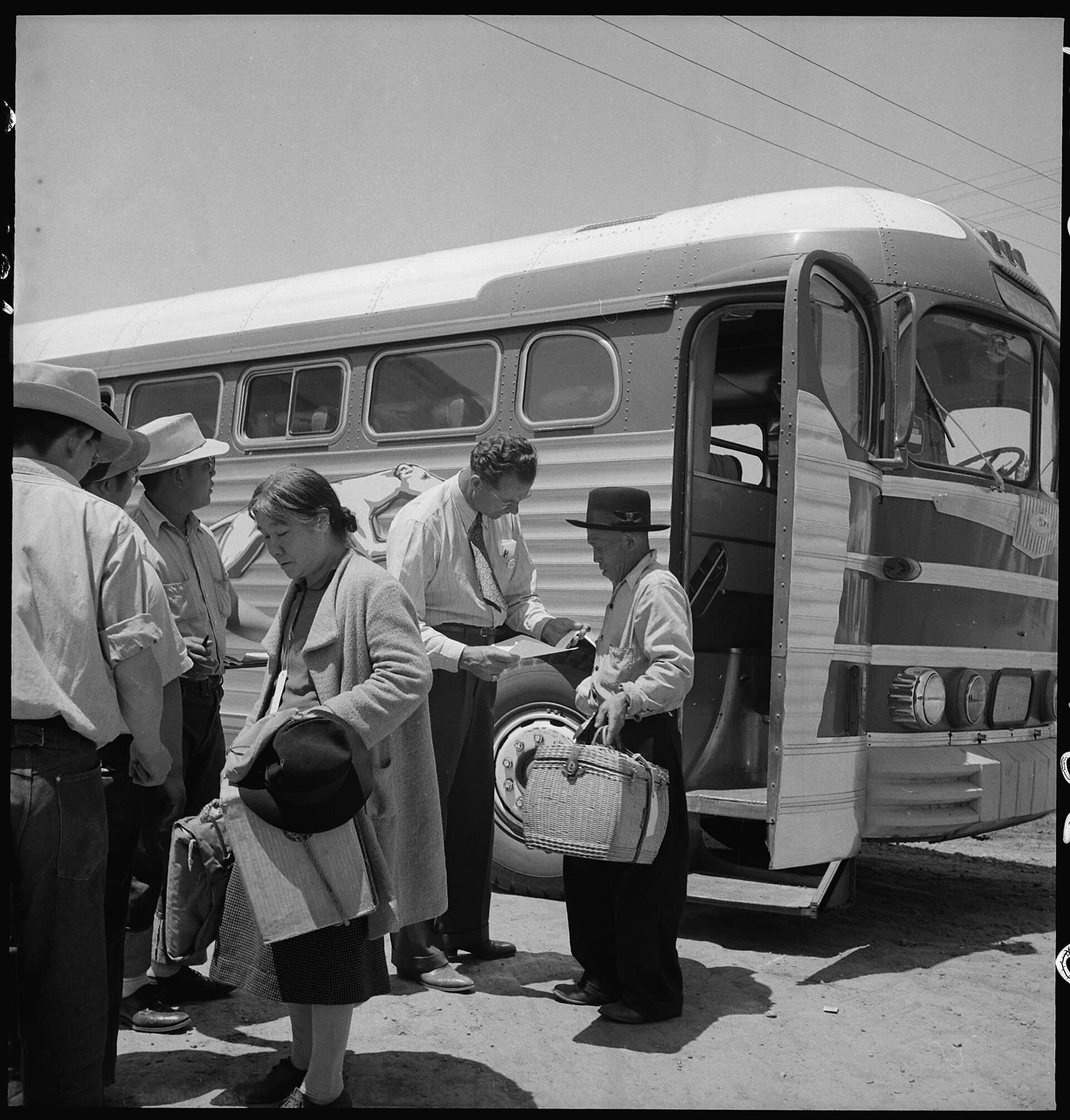
People of Japanese ancestry from the Lodi grape-producing district at Stockton during forced removal, 1942.
Dorothea Lange / War Relocation Authority / U.S. National Archives, NAID 537718. Public domain. (opens in a new tab)Audio story · 6:12
Listen where the story happened.
View the Lodi Armory from the public right-of-way only. Take in the exterior without approaching entrances or treating the property as open to visitors.
Listen to the story
The player stays with you while you open the route, sources, or next chapter.
Complete transcript
Begin with the boundary
Remain on the public right-of-way. Do not approach an entrance or assume the property is open to visitors. Take in the Armory's exterior from a respectful distance.
This chapter begins with a firm boundary. The building is documented. One oral-history record connects it to the forced removal and incarceration of Japanese Americans from the Lodi area. But the federal record needed to establish the Armory's exact function, date, and number of people has not yet been located.
We will not turn that gap into certainty.
What is established
The City's historical inventory dates the Lodi Armory to 1930. The building was determined eligible through a federal review process and is listed in the California Register.
That gives us a solid architectural and designation frame. This is not merely an old-looking building or a research candidate. Its historical significance has formal recognition.
An armory represents organized state capacity. It is a place associated with training, equipment, administration, readiness, and the physical presence of government power. That general function makes the oral-history connection especially consequential—but it does not prove the specific wartime role by itself.
Historical interpretation has to resist a common shortcut: a building's institutional type feels consistent with a story, so the story is treated as confirmed. Plausibility is not documentation. The more serious the claim, the more important that distinction becomes.
A recollection is evidence
An oral history archived by NDAJAMS connects this Armory to Lodi's Japanese American forced-removal and incarceration history.
Oral history is evidence. It preserves experience, memory, language, emphasis, and relationships that official files may omit. It can identify a place researchers would not otherwise know to investigate. It can also compress time, inherit family retellings, or use a familiar building name for a nearby event. Those possibilities do not make a recollection disposable. They tell us what kind of corroboration to seek.
The wrong response would be to dismiss the account because it is oral. Another wrong response would be to upgrade it silently into a precise federal fact.
The responsible response is attribution: name the kind of source, state what it connects, and identify exactly what remains unresolved. That approach respects the testimony enough to follow it—and respects the public enough not to overstate it.
The archival mission
The missing documentation is concrete. Researchers need the federal order, roster, transport record, correspondence, facility log, newspaper coverage, or related administrative file that establishes what happened here, when, and to whom.
Until that record is located, this script must not call the Armory an assembly center. It must not publish a precise date or count. Those terms and numbers carry legal, institutional, and human meaning.
The gap also reveals something about archives. Government actions can generate enormous quantities of paperwork while still leaving local experiences difficult to trace. Records may be dispersed across federal collections, state holdings, local newspapers, institutional files, and family archives. Finding the right document requires knowing not only the subject but the bureaucratic vocabulary that created it.
The oral history gives this project a lead. The building gives the lead a place. The unresolved record gives future work a clear target.
Do not make the building confess
Look at the Armory again. Architecture can make a claim feel true because the building seems capable of containing it. But walls do not certify every story attached to them.
The ethical task is not to make the building confess. It is to assemble evidence around it: designation records, oral testimony, federal documents, local reporting, photographs, maps, and community knowledge.
This is also living community history. Descendants and community organizations may know records, names, terminology, and harms that an outside research team misses. Their review is not a decorative approval step. It can materially change the interpretation.
Until then, the audio should preserve the uncertainty in its structure. The first part tells you what is established. The second tells you what is attributed. The third tells you what must be found.
An unfinished record is still a result
Before leaving, hold two truths together.
First: the 1930 Lodi Armory is formally recognized as a California Register resource. Second: an archived oral history connects it to forced removal, but the exact wartime function, date, and number of people remain unconfirmed in the current federal record.
That is not an unsatisfying ending. It is an accountable one.
Public history loses trust when uncertainty is hidden behind confident narration. It gains trust when the audience can see the line between evidence and inference—and when an unresolved claim becomes a specific research mission rather than a rumor repeated forever.
This chapter should change when better records or community knowledge arrive. The correction should be visible. The source trail should remain open. For now, let the building stand not as proof of a completed story, but as the place where the next archival question begins.
Read the place
A chapter is an argument built from checkable claims—not a pile of local trivia.
The 1930 Lodi Armory is a California Register-listed resource. An archived oral-history account connects the building to the forced removal of local Japanese Americans, but the federal order or roster needed to establish its exact function, date and number of people has not yet been located.
Why it matters
Showing the unresolved record is more honest than turning a powerful recollection into false certainty—and it gives the project a concrete archival mission.
Evidence ledger
The story, claim by claim.
The central account comes from a credible source but has not been independently confirmed. Every receipt names the source and the exact place to look.
How the evidence key worksClaim 01
DocumentedBuilt in 1930, the Lodi Armory was determined eligible through federal review and is listed in the California Register.
Receipts
- SupportsHistorical Resource Inventory: Lodi Downtown Specific Plan Area (opens in a new tab)Table 1 and Appendix C: Lodi Armory, status 2S2
Claim 02
ReportedAn oral history archived by NDAJAMS connects the Armory to Lodi's Japanese American forced-removal and incarceration history. We have not yet found the federal record needed to establish the building's exact role, date or number of people.
Evidence note: Never call the building an assembly center or publish a precise date or count without the relevant federal record.
Receipts
- SupportsLodi Armory Oral History (opens in a new tab)Oral-history item record
- ContextExecutive Order 9066: Resulting in the Relocation of Japanese (opens in a new tab)Executive Order and historical note
Source shelf
Read past the plaque.
Source notes say what each record establishes—and just as importantly, what it does not.
- 01
GPA Consulting · City of Lodi · 2026-01
Authoritative for the survey's resource-status findings. The 118 properties are reconnaissance candidates, not designated landmarks; narrative chronology still requires claim-level checking.
Accessed 2026-09-03 · link only
- 02Lodi Armory Oral History (opens in a new tab)Institutional history
National Digital Archive of Japanese American Military Service
Supports publication only as a named oral-history account. It does not yet establish an official assembly-center designation, exact date or count.
Accessed 2026-09-03 · link only
- 03
National Archives · 1942-02-19
Primary federal record for the government authority behind forced removal and incarceration; not a Lodi removal roster.
Accessed 2026-09-03 · public domain
- 04Terminology and the Mass Incarceration of Japanese Americans during World War II (opens in a new tab)Institutional history
National Park Service
Editorial guidance for accurate, non-euphemistic language.
Accessed 2026-09-03 · link only
Beyond the walking route
This bonus chapter sits outside the nine-stop walk.
Return to the route whenever you are ready to follow the downtown story in order.
Return to the route