Stop 07 · 1890s–1942
Two Blocks, a Whole World
Two blocks held a whole community. Federal forced removal and incarceration broke it apart.
- Place
- 4–20 N. Main Street and 23 N. Stockton Street
- Chapter
- fracture
- Time here
- 12 minutes
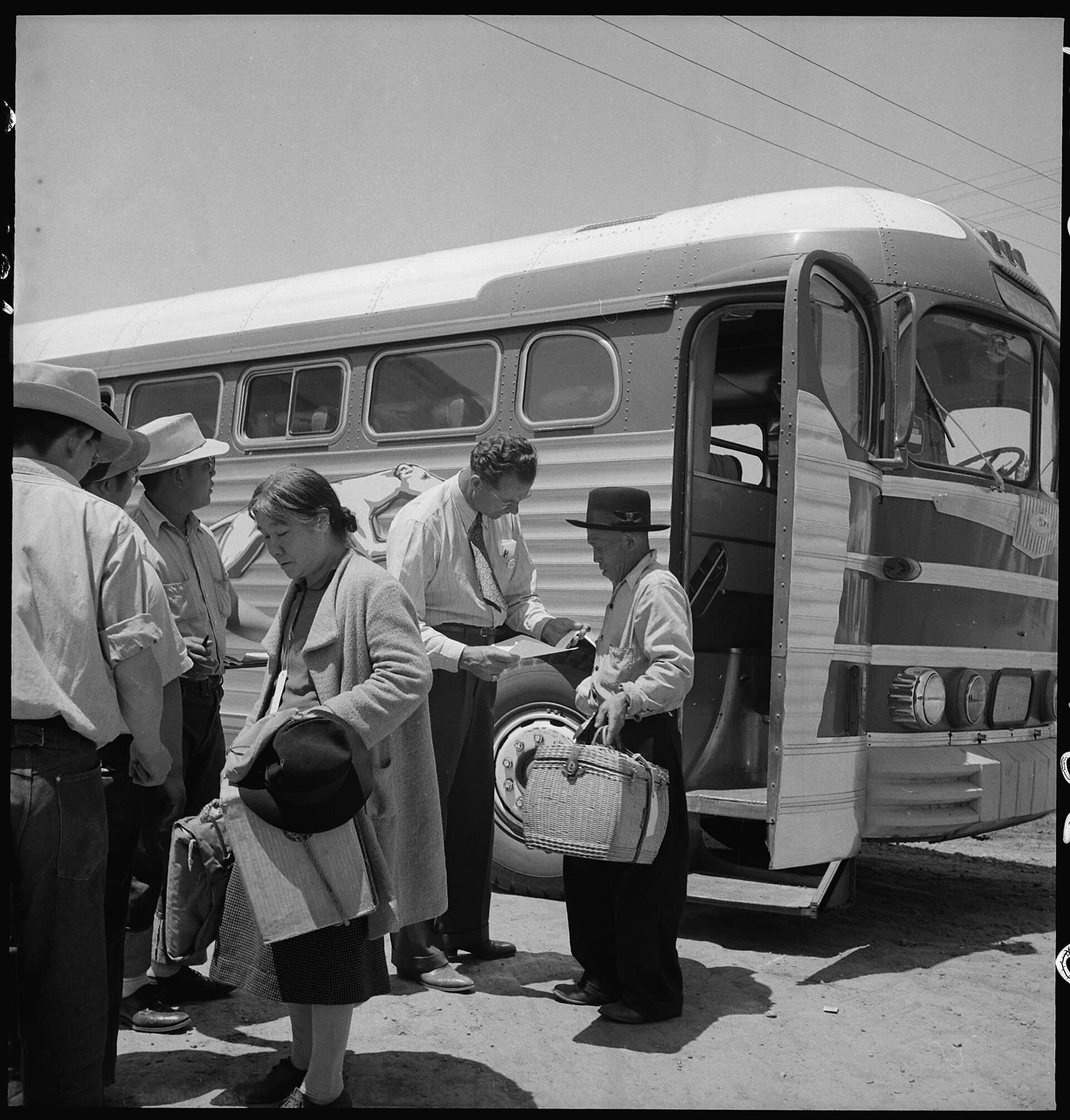
People of Japanese ancestry from the Lodi grape-producing district at Stockton during forced removal, 1942.
Dorothea Lange / War Relocation Authority / U.S. National Archives, NAID 537718. Public domain. (opens in a new tab)Audio story · 6:40
Listen where the story happened.
From the public right-of-way on North Main Street, take in the block as a district rather than approaching any individual property.
Listen to the story
The player stays with you while you open the route, sources, or next chapter.
Complete transcript
See a district, not an empty stage
Stay on the public right-of-way. Do not enter private property, and do not treat current homes or businesses as exhibits. Look along the block instead of focusing on one doorway.
This chapter concerns a Japanese American community that built a dense civic and commercial world around these streets—and the federal action that broke it apart in 1942. It is living community history, not an atmospheric story about an abandoned district. Community review is still pending, and that review may change this script.
Begin by refusing the easiest mistake: absence today does not mean there was little here before.
The community people made
Preserving California's Japantowns estimates that by 1940 roughly eight hundred Japanese residents in the area sustained stores, restaurants, hotels, a laundry, a tofu maker, social organizations, and a Buddhist church.
Read that list slowly as a system. Food, lodging, clothing, work, worship, association, and mutual support. A store is not only inventory. A hotel is not only rooms. A church is not only a building. Together, institutions allow people to arrive, earn, gather, exchange news, maintain culture, raise families, and help one another through uncertainty.
The district also served seasonal agricultural workers. That connects this small urban geography to the wider fields and harvest economy around Lodi. Main Street was not separate from agriculture. It was part of the human infrastructure that made agricultural work possible.
The City's January 2026 survey identifies these Main Street blocks as a potentially eligible historic district. They are not a designated district. Again, precision matters. The survey recognizes a concentration of historical resources and associations that may warrant fuller evaluation. It does not complete that evaluation or confer formal protection.
The state closes the district
In May 1942, Japanese American businesses here closed as the United States government forcibly removed and incarcerated people of Japanese ancestry under the program enabled by Executive Order 9066.
The language must remain clear. This was not a voluntary evacuation. Families did not simply decide to relocate. Federal power defined people through ancestry, imposed removal, and confined them.
The effects on a district like this were immediate and layered. A business cannot remain a neighborhood institution when its owners and customers are forced away. A religious community cannot gather normally when its members are removed. Property, inventory, income, education, relationships, and the ordinary continuity of daily life are all put at risk.
We should not manufacture a single dramatic scene for this block. Forced removal unfolded through orders, deadlines, logistics, waiting, sale or storage of belongings, transport, and uncertainty. The documented harm does not need theatrical enhancement.
Pause here for a few seconds. Let the present street sound continue.
What survives and what does not
Some buildings connected to Lodi's Japantown survive. Survival can help recover the district's geography, but a facade cannot speak for every person who lived or worked here.
To reconstruct the fuller community, researchers need directories, photographs, newspapers, business records, temple and church archives, family collections, oral histories, property files, and the knowledge of descendants. Those sources can restore names and relationships that a building survey alone cannot.
There is also a responsibility in how visitors behave. Do not peer into windows, enter private spaces, or assume a current occupant represents the history being discussed. The ethical way to experience this chapter is to observe the public streetscape, use the documented record, and make room for community authority over how the story is told.
The phrase “two blocks, a whole world” is not nostalgia. It is a description of civic density. Communities often create far more social infrastructure than official maps record. When the state removes the people who sustain that infrastructure, the loss exceeds the number of buildings left vacant.
Make the erased geography visible
Look along the block once more. Try to hold both layers at the same time: the present-day street and the earlier network of stores, restaurants, hotels, laundry, tofu production, organizations, and Buddhist community described in the historical record.
Then hold the rupture. In 1942, the federal government forcibly removed and incarcerated people of Japanese ancestry. Businesses closed. Families were uprooted. A civic geography built through work and mutual dependence was broken apart.
The surviving structures matter because they make denial harder. But preservation without names, testimony, and community review can still leave the central history thin.
This script is a starting frame, not ownership of the story. Before it becomes final audio, the project must invite review from people with community knowledge and make corrections visible. The goal is not to turn suffering into a dramatic stop. It is to recognize what Japanese American residents created here, state plainly what government power did, and help the city see a world that the present streetscape no longer fully reveals.
Read the place
A chapter is an argument built from checkable claims—not a pile of local trivia.
Hotels, stores, restaurants, a bathhouse and a Buddhist church served Japanese residents and seasonal agricultural workers around Main Street. In 1942, the U.S. government's forced-removal program closed businesses and uprooted families from the district.
Why it matters
The surviving buildings make an erased civic geography visible. This is a story of community creation, state action and endurance—not an atmospheric tale of abandonment.
Evidence ledger
The story, claim by claim.
The central account comes from a credible source but has not been independently confirmed. Every receipt names the source and the exact place to look.
How the evidence key worksClaim 01
DocumentedThe City’s January 2026 survey identifies these Main Street blocks as a potentially eligible historic district—not a designated district.
Receipts
- SupportsHistorical Resource Inventory: Lodi Downtown Specific Plan Area (opens in a new tab)Section 5.1 and Appendix D
Claim 02
ReportedPreserving California's Japantowns estimates that by 1940 roughly 800 Japanese residents in the area sustained stores, restaurants, hotels, a laundry, a tofu maker, social organizations and a Buddhist church.
Receipts
- SupportsPreserving California's Japantowns — Lodi (opens in a new tab)Lodi overview, paragraphs 2–4
Claim 03
ReportedIn May 1942, Japanese American businesses here closed as the U.S. government forcibly removed and incarcerated people of Japanese ancestry under the program enabled by Executive Order 9066.
Evidence note: Do not describe the process as voluntary evacuation or reduce it to movement between locations.
Receipts
- SupportsPreserving California's Japantowns — Lodi (opens in a new tab)Nippon Drugstore and evacuation-era property histories
- ContextExecutive Order 9066: Resulting in the Relocation of Japanese (opens in a new tab)Executive Order text and historical note
- ContextTerminology and the Mass Incarceration of Japanese Americans during World War II (opens in a new tab)Terminology guidance
Source shelf
Read past the plaque.
Source notes say what each record establishes—and just as importantly, what it does not.
- 01
GPA Consulting · City of Lodi · 2026-01
Authoritative for the survey's resource-status findings. The 118 properties are reconnaissance candidates, not designated landmarks; narrative chronology still requires claim-level checking.
Accessed 2026-09-03 · link only
- 02Preserving California's Japantowns — Lodi (opens in a new tab)Institutional history
Preserving California's Japantowns
Statewide survey and community research on Lodi's surviving Japantown buildings and prewar community.
Accessed 2026-09-03 · link only
- 03Buddhist Church of Lodi — Church History (opens in a new tab)Institutional history
Buddhist Church of Lodi
Community-authored institutional history; lived-community authority should be preserved in attribution.
Accessed 2026-09-03 · link only
- 04
National Archives · 1942-02-19
Primary federal record for the government authority behind forced removal and incarceration; not a Lodi removal roster.
Accessed 2026-09-03 · public domain
- 05Terminology and the Mass Incarceration of Japanese Americans during World War II (opens in a new tab)Institutional history
National Park Service
Editorial guidance for accurate, non-euphemistic language.
Accessed 2026-09-03 · link only
Next stop · 08
When Lodi Went Dark
When the horn sounded, the town went dark.